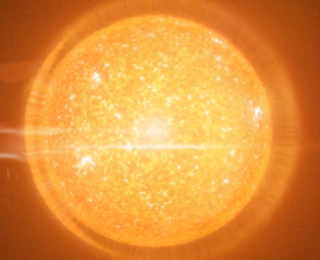
Seeing Stars: Juicing up JWST with 5000x Magnification
We pointed JWST at a galaxy magnified 5000 times by the universe–what did we learn by seeing the unseeable?

We pointed JWST at a galaxy magnified 5000 times by the universe–what did we learn by seeing the unseeable?
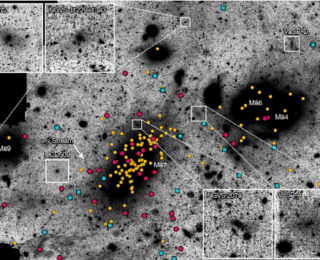
In today’s bite, we look at some newly observed systems in the Virgo cluster. These observations provide clues to understanding how some of the most dense galaxies known to us form.
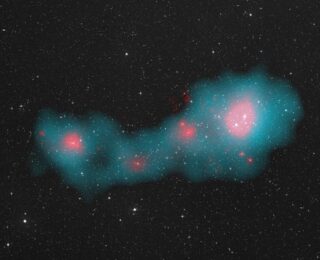
The Shapley Supercluster is widely recognised as the most massive gravitationally bound structure in the local universe.The supercluster is made up of 11 galaxy clusters and groups and extends across ~ 260 megaparsecs. At its core, which this paper focuses on, are five clusters. This core hosts several radio haloes,which are caused by shock-heated gas from the Intracluster medium (ICM) and is evidence of ongoing cluster merger activity. This supercluster core is highly dynamically active (full of cluster-cluster mergers), which could influence the evolution of galaxies within the core. This paper examines the evolution of galaxies by observing the cold gas within galaxies (i.e. the neutral hydrogen) and compares several galaxy properties to do so (see also: this previous Astrobite featuring ram-pressure stripped galaxies in the Shapley Supercluster).
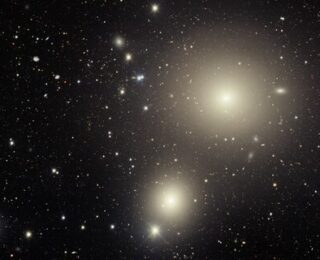
Galaxy clusters are collections of galaxies that are bound together by gravity. They are the largest structures that exist in our Universe, and their mass is dominated by the hot gas that lies between galaxies called the intracluster medium. One of the closest galaxy clusters is Fornax, and it was recently studied in detail using the MeerKAT radio telescope in South Africa. This bite dives deep into a study of the magnetic field of this cluster and the implications the results have of our understanding of clusters of galaxies.
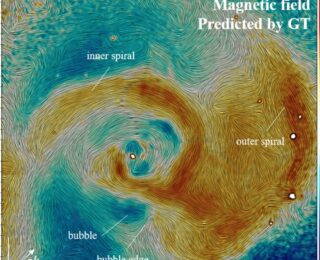
In today’s paper, the authors use their Gradient Technique to estimate the plane of sky magnetic fields in several bright clusters.
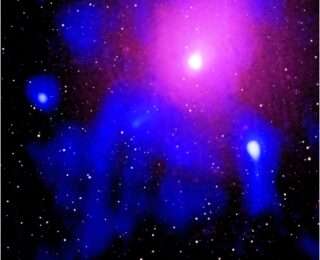
There is a lot we don’t understand about the gas in galaxy clusters. Today’s paper provides new insight using a powerful X-ray space telescope!