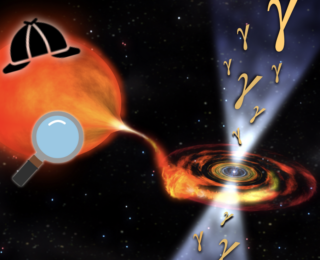
The Case of the Extremely Energetic Gamma Rays: an LS I +61 303 Mystery
In today’s bite, the LHAASO collaboration tackle a gamma ray mystery in the LS I +61 303 system, investigating just who (or what) might be responsible.

In today’s bite, the LHAASO collaboration tackle a gamma ray mystery in the LS I +61 303 system, investigating just who (or what) might be responsible.
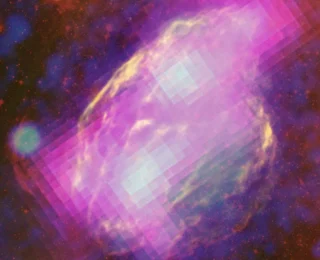
Today’s astrobite looks at how we can use observations of gamma-rays and neutrinos to test our models of cosmic rays.
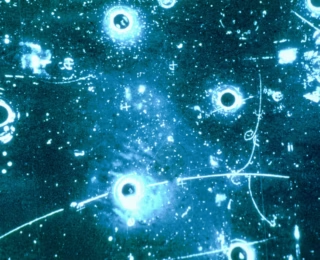
In February 2023, the KM3NeT underwater observatory observed the highest-energy neutrino ever detected. Did it come from a dying primordial black hole?
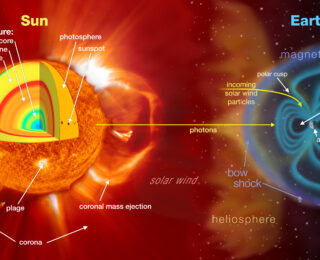
The Sun doesn’t just shine—it also shapes the high-energy γ-ray sky by interacting with cosmic rays. Using 15 years of Fermi-LAT data, researchers detected the solar γ-ray halo in unprecedented detail and linked it to the same cosmic ray electrons measured near Earth. This study reveals how γ-ray observations can uncover the invisible influence of the Sun’s magnetic field across the heliosphere.
This study by the LHAASO Collaboration presents the first measurement of diffuse gamma-ray emissions in the 1–25 TeV range, revealing excess flux beyond theoretical predictions. The findings suggest hidden gamma-ray sources, such as pulsar wind nebulae or massive star clusters, and indicate spectral variations across the Galactic plane. These results challenge existing cosmic-ray transport models and highlight the need for further observations and refined theoretical frameworks.
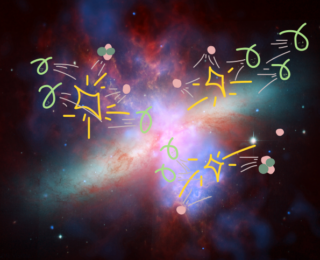
The latest results from the VERITAS gamma-ray telescopes hint that starburst galaxies like M 82 might help us understand where mysterious cosmic rays come from!