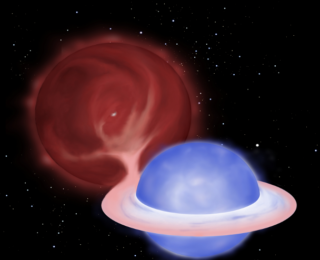
UR: Blue stars that should not exist
In the latest of our #UndergradResearch series, discover Yanbo Pan’s work on the evolution of blue straggler stars.

In the latest of our #UndergradResearch series, discover Yanbo Pan’s work on the evolution of blue straggler stars.
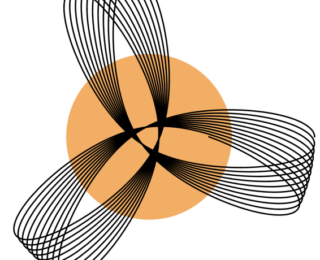
What might the orbit of a primordial black hole going in and out of a Sun-like star look like?
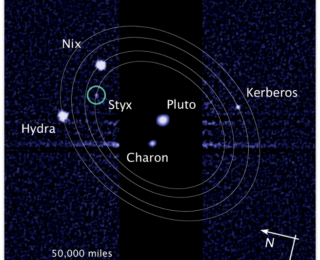
Pluto and Charon form a binary system. Around their barycenter, four recently discovered moons are orbiting: Styx, Nix, Kerberos and Hydra. In this work, two separate approaches were utilized to model their orbits. At first, all bodies were simulated using an n-body integrator and then outcomes were validated by a theoretical model. The motions that the four small moons follow are a superposition of forced oscillations by the binary system and mutual gravitational interactions. Results indicated that we cannot use Keplerian elements to describe the circumbinary orbits, as the central potential by the dwarf binary planet forces the small moons into several oscillations. Even when demanding a zero-orbital eccentricity, distances appeared to have many fluctuations through time. Lastly, we noticed that the mutual effects induce many long period perturbations, especially for the lighter moons, whereas the binary effects mainly dominate in the high frequency region.
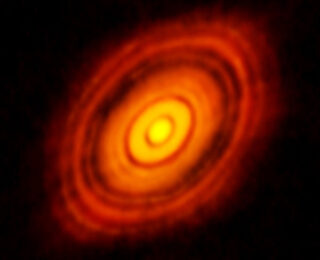
In today’s paper, the authors analyze millimeter and submillimeter ALMA observations of a protoplanetary disk, and find kinematic signs of candidate companions within!
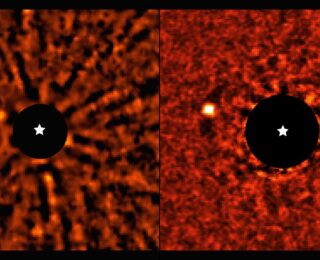
Direct imaging exoplanets is difficult, but a new method of vetting targets has just helped three independent teams discover, and image, a new gas giant.
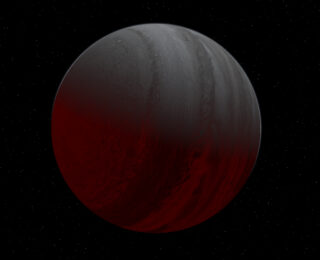
In today’s paper, the authors take another look at the HD 45354 planetary system, and come to new conclusions about the orbit of the two gas giants within!