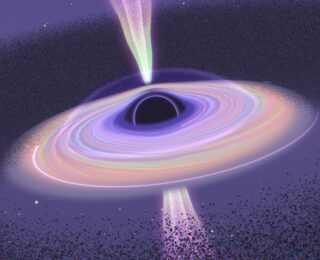
Forever Alone: A Black Hole Destined to Stay too Big
This ancient black hole is far too massive for its galaxy. Thirteen billion years later, it might still be haunting us.

This ancient black hole is far too massive for its galaxy. Thirteen billion years later, it might still be haunting us.
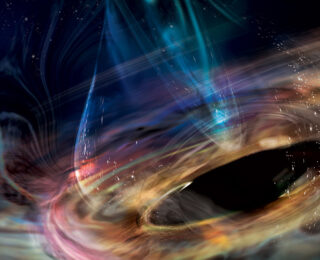
Eating matter is what black holes do best, but what happens when we find one choking on its food? The answer might surprise you!
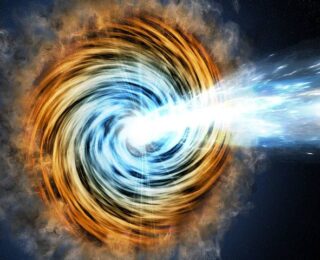
Today’s authors consider the way AGN jet shape changes our measurements of blazar polarization.
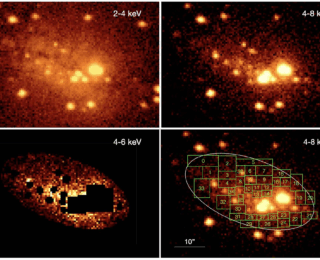
Cosmic rays, born from powerful events like exploding stars, are a key but elusive part of a galaxy’s interstellar medium. Today’s paper combines gamma-ray, X-ray, infrared, and radio observations of M82 to untangle how cosmic rays and magnetic fields shape its energetic core.
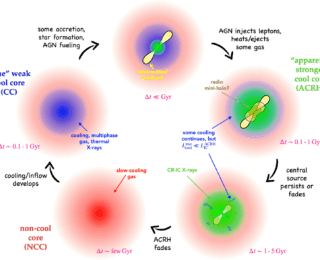
It is generally believed that the X-ray emission from cold-core clusters comes from hot gas, where there is a delicate balance between gas cooling and feedback from active galactic nuclei. This paper explores another possibility: are these X-rays simply an illusion of inverse Compton scattering by cosmic rays?
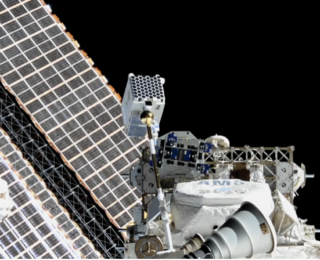
From Sahana Parker: How NASA scientists, engineers and astronauts pulled off a high-stakes space telescope repair—one patch at a time!