
Paper Title: Formation of supermassive stars and dense star clusters in metal-poor clouds exposed to strong FUV radiation
Authors: Sunmyon Chon, Kazuyuki Omukai
First Author’s Institution: Max-Planck-Institut für Astrophysik, Garching, Germany
Status: published in Monthly Notices of the Royal Astronomical Society [open access]
Supermassive Stars
The astronomical community is in good agreement that nearly every known galaxy contains a supermassive black hole – a black hole with a mass of at least a million times the mass of the sun, or solar masses – at its center. Astronomers have also observed these black holes in some of the earliest known galaxies just a few hundred million years after the Big Bang. However, it is not clear how such massive black holes form at such early times.
One theory is that these massive black holes are born from the deaths of supermassive stars. Supermassive stars are thought to form in the early universe under special conditions. In a pre-galactic halo of gas, dust, and dark matter, the halo will eventually become massive enough for the gas to cool and collapse towards the center. Normally, “coolants” like metals and molecular hydrogen start a process called fragmentation, where the gas fragments into high-density pockets that lead to the formation of star clusters. However, if the concentration of coolants is low enough (and/or if the collapsing gas is flowing into the center quickly enough), gas can be funneled towards one or more supermassive stars (SMSs) at the center of the halo.
Today’s authors examine the characteristics of these SMS systems – the SMS masses, how the masses evolve with time, and how much gas gets accreted onto these stars instead of forming new stars. They then look at how these properties change with increasing metallicity by modeling the complex physical processes that impact these properties, such as radiative feedback, thermal heating, and metal cooling.
The authors begin by initializing spherical clouds of gas and dark matter and tracking them until they gravitationally collapse and form their first star. From here, they isolate a sphere of material around star inside a radius of 1 million astronomical units (AU), and perform high-resolution simulations of the complex physics occurring in these regions. The main physical processes they consider in these simulations are:
- Chemical reactions among electrons, hydrogen atoms, hydrogen ions, and hydrogen molecules. They also account for the heating and cooling processes of these chemical species, as well as metal-line cooling for carbon and oxygen.
- Heating and cooling of dust via its interactions and energy transfer with gas.
- Radiation and radiation feedback from stars. Note that several stars (and potentially even multiple SMSs) form during the high-resolution simulations after the first star forms.
The authors also test how the results in each region depend on the metallicity, varying this input parameter to their simulations. The consider five different cases of metallicity Z, ranging in powers of ten from 10-6 to 10-2. In the figures below and throughout the remainder of this article, this is represented as [Z/H] between -6 and -2.
Cannibalism with a Side of Super-Competitive Accretion
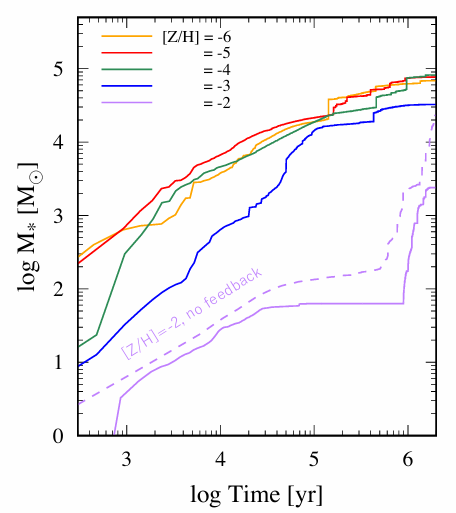
The first main result are the growth histories of the most massive SMS in each run, shown in Figure 1. All of the low-metallicity models are able to achieve a maximum stellar mass of over 104 solar masses, but the [Z/H] = -2 model struggles to produce a star above 103 solar masses when stellar feedback is included. This model is the only one that fails to produce a star that reaches the 104 solar mass threshold for an SMS.
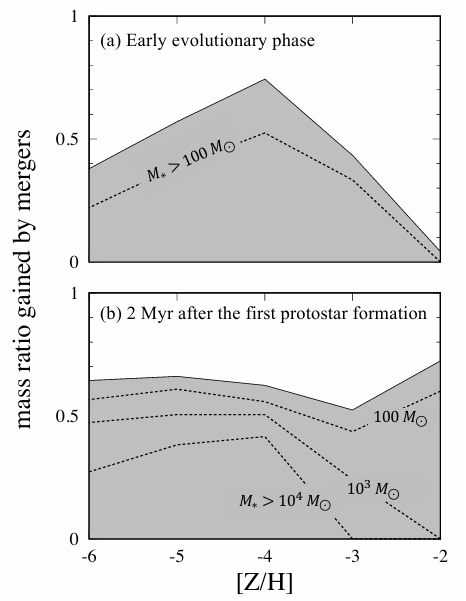
Next, they look at the total mass of the most massive SMS at the end of the simulation and determine how much mass it obtained via mergers and how much was from accreted gas. This ratio of merger mass to gas mass is shown in Figure 2 for each metallicity. During their early evolution, SMSs that form in clouds with intermediate metallicities ([Z/H] ≈ -4) tend to get a significant portion of their mass from mergers, but those that form in clouds with more extreme metallicities tend to gain more mass via gas accretion. Over their long-term evolution, this trend flattens out, with most SMSs tending to gain about 60% of their mass via mergers. Mergers with more massive stars drop sharply at higher metallicities since star formation occurs more easily, forming large amounts of less massive stars.
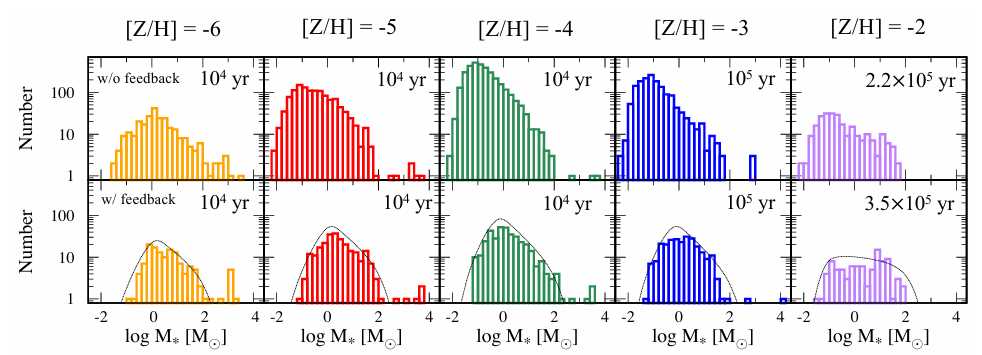
Next, the authors look at the masses of all the stars that formed during the early evolution of each simulation. These distributions are shown in Figure 3. The clouds tend to form more stars with intermediate metallicities, and most stars that form have a mass similar to the mass of the sun or lower. Only a couple stars form with masses above 100 solar masses. The distributions are more even across metallicities when stellar feedback is included, though in both cases, high metallicity prevents stars above 100 solar masses from forming after a few hundred thousand years. A star with a mass of ~1000 solar masses forms after 1 million years (see Figure 1), which is after the output time for the distributions shown here.
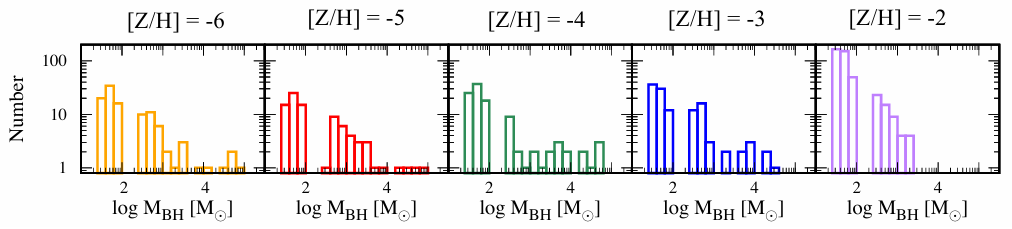
Finally, they consider the masses of the black holes produced from these stars; these distributions are shown in Figure 4. Simulations with metallicities [Z/H] ≤ -3 produce a few heavy seed black holes with masses ≳ 104 solar masses, as well as a larger population of black holes below 1000 solar masses. Since the simulation with the highest metallicity fails to produce an SMS, it also fails to produce similarly heavy black holes.
Today’s paper has a main implication for the formation of supermassive black holes: SMSs could be a viable formation channel, but only if the metallicity is low enough (in this case, meaning [Z/H] ≲ -3). It may still be possible with higher metallicities, but it doesn’t produce some of the most massive black holes like at lower metallicities, so these black holes would need to grow faster since they have more ground to cover. Today’s authors also note that there are some physical processes related to SMS formation and evolution that their simulations do not cover, such as magnetic fields and mass loss via stellar winds and during mergers. These phenomena could serve to limit the final masses of SMSs and would make it less likely that massive black holes formed from SMSs.
Astrobite edited by Kaz Gary
Featured image credit: NASA/JPL-Caltech

This is amazing.