
Authors: F. P. Callan, C. E. Collins, S. A. Sim, L. J. Shingles, R. Pakmor, S. Srivastav, J. M. Pollin, S. Gronow, F. K. Röpke, and I. R. Seitenzahl
First Author’s Institution: Astrophysics Research Centre, School of Mathematics and Physics, Queen’s University Belfast, UK
Status: Published in Monthly Notices of the Royal Astronomical Society [open access]
The classification of supernovae has evolved as modern telescopes have become better at revealing distinct features called absorption or emission lines in the spectra of these explosive events. Type Ia supernovae (SNe Ia) were originally classified by the absence of hydrogen observed in their spectra. Hydrogen, then, became a key distinguishing feature: it was missing in type Ia supernovae but prominent in type II supernovae. As astronomers continued to study supernovae, they began detecting additional patterns in the elemental composition of the spectra, leading to a more refined classification system. These elements are key to unlocking the mystery of how all these kinds of supernovae formed in the first place. What other stories might these elements tell?
Type Ia supernovae have been instrumental in measuring the expansion rate of the universe because of their inherent luminosities, which were long believed to be similar. This led to their nickname of “standard candles”. Over time, however, type Ia supernovae have shown that they might not all share similar intrinsic luminosities, or, in other words, they might not be as uniform as we thought. Their role as standard–or better yet, standardizable–candles is complicated because there are likely multiple formation mechanisms that produce a type Ia supernova (see Figure 1).

One promising theory for producing SNe Ia is the “double detonation” model. In this scenario, a white dwarf star—comparable in mass to our Sun—has an onion-like structure, with an inner carbon-oxygen core surrounded by a thin outer helium “shell”. The explosion begins when this outer helium layer ignites. The shock from this initial detonation then triggers another detonation within the core of the white dwarf, completely ripping the star apart into a fiery supernova. The initial mass of helium in this outer shell depends on whether the initial white dwarf steals mass from a more massive star or another white dwarf. Regardless of the source of this helium, however, a characteristic feature of this explosion is a significant amount of unburned helium (~0.01 M☉ to ~0.1 M☉) in the explosion’s outer ejecta, the material left behind after the detonation.
Today’s authors investigated whether this unburned helium and its spectral signatures can indicate a type Ia supernova that formed from the double detonation scenario.
Let’s get elemental!
A common approach to calculating the elements produced in a supernova explosion and simulating the explosion’s subsequent spectra is through a multidimensional radiative transfer code–a type of code that simulates how electromagnetic radiation, like light, propagates through a medium. Because a spectrum of an object reflects the combined signatures of all the object’s elements, radiative transfer codes allow researchers to construct the synthetic, or model, spectra of theoretical supernovae, which can then be compared to the spectra from real events.
In this paper, the authors used a code called ARTIS, which incorporates advanced physics to describe collisions energized by astrophysical phenomena, a crucial component needed to model the expected helium spectral features. To represent a double detonation event, the authors created a one-dimensional (1D) ejecta model derived from a more complex three-dimensional (3D) simulation. Their simulations covered 1.5 to 35 days after the explosion, encompassing the expected period where the most prominent spectral lines occur.
Helium as a diagnostic
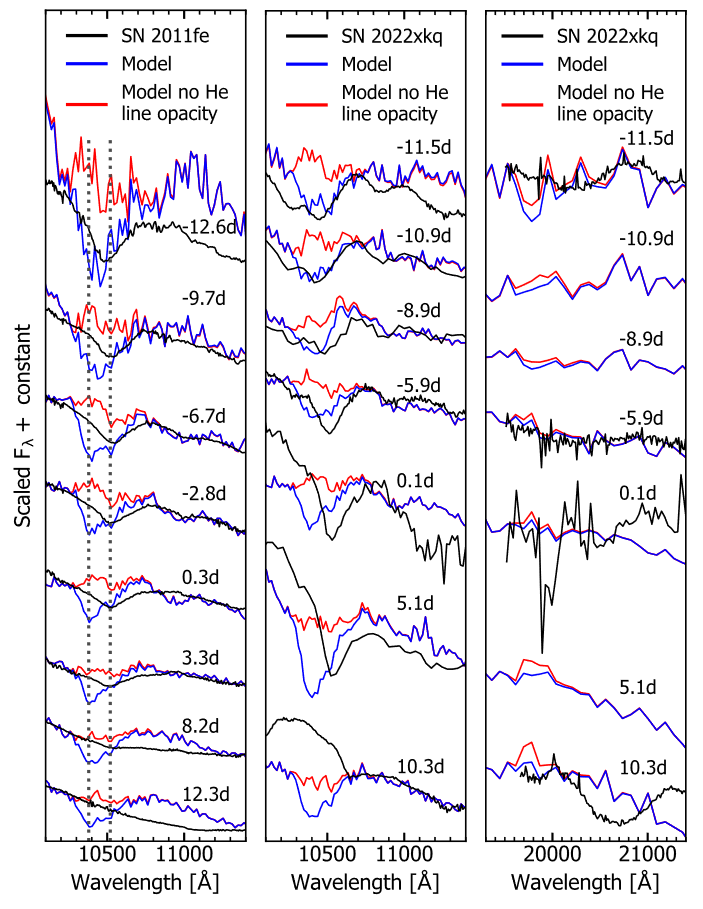
When talking about spectra, astronomers generally refer to specific absorption or emission lines by their wavelengths in Angstroms (Å), a unit of length equal to one ten-billionth of a meter. In this study, the simulations predict a strong and persistent absorption feature in the near-infrared centered around 10,830 Å, which corresponds to neutral helium (He I)–helium that has not been ionized, or excited, and is likely unburned. However, additional helium features expected in the optical regime, at lower wavelengths, were not seen. These missing lines could have corroborated the prominent He I 10,830 Å feature, providing additional support for the presence of unburned helium.
Although other prominent helium (He I) lines were absent in the simulations, the He I 10,830 Å line may partially contribute to a neighboring magnesium Mg II 10,927 Å feature (see dashed lines on the left of Figure 2). Determining whether the absence of other helium lines and this overlap with magnesium are robust features of the model will require further investigation. Regardless, the authors believe that the prominent He I 10,830 Å feature is a promising observable signature of the double detonation scenario, unlocking a potential tool for detecting the double detonation formation mechanism for type Ia supernovae.
How does this compare to the real world?
With the synthetic spectra generated, the authors compared them to two well-studied events in the real Universe: SN 2011fe, a canonically “normal” SN Ia, and SN 2022xkq, a “transitional” SN Ia that does not neatly fit into the standard classification of “normal” (see Figure 2). These two events have been observed extensively for various reasons, allowing for better comparison with the synthetic spectra.
When compared against SN 2011 fe, the He I 10,830 Å feature of the simulations seems significantly stronger, suggesting that the amount of unburned helium in this study’s model is perhaps on the higher side of the expected range for “normal” type Ia supernovae. Future simulations with less massive helium shells and unburned helium in the outer ejecta might help clarify the relationship between the He I and Mg II lines and better align with observations. In contrast, when compared to SN 2022xkq, the He I 10,830 Å appears slightly less prominent, suggesting that the overall brightness of the authors’ double detonation model explosion lies between a normal SN Ia and a “transitional,” less luminous SN Ia. This also hints that the strength of the helium feature is sensitive to the explosion’s brightness and ejecta composition.
Overall, this work suggests that the prominent He I 10,830 Å feature might be a promising observational probe in identifying type Ia supernovae formed via the double-detonation scenario. While future work varying the helium shell mass would provide more support, this work provides an important step forward for supernova enthusiasts.
Astrobite edited by Shalini Kurinchi-Vendhan
Featured image credit: Mckenzie Ferrari (made in Canva)
