
Title: Leaky dust trap in the PDS 70 disk revealed by ALMA Band 9 observations
Authors: A. Sierra, M. Benisty, P. Pinilla, L. Pérez, P. Curone, K. Doi, S. Facchini, D. Fasano, S. Andrews, J. Bae, J. Carpenter, I. Czekala, A. Isella, N. Kurtovic, F. Menard, R. Teague
First Author’s Institution: Mullard Space Science Laboratory, University College London, Holmbury St Mary, Dorking, Surrey RH5 6NT, UK
Status: Open access
Building a planet and creating life on it is a long and complicated process, and unfortunately we haven’t found the construction manual for Earth yet (or any of the other planets for that matter). Instead, we can learn a lot about how planets form by observing protoplanetary discs around other stars, since these discs contain the building blocks of planets – dust, ice, and gas. Planets formed in protoplanetary discs can carve gaps in them, creating rings that can sometimes be ascribed to the existence of a planet. We can observe these rings with instruments like the Atacama Large Millimetre Array (ALMA). Using ALMA, the authors of today’s article have observed the planet-carved ring around the young star PDS 70 and may have found game-changing evidence supporting an important theory in the evolution of these planet-forming discs: how to sneak dust and possibly water ice past a planet.
To understand this, we first need a little protoplanetary disc physics. These discs have a lot of dust and gas orbiting the central star. The dust orbits the star at a Keplerian velocity (no funny effects going on here, so it orbits like a planet) but the gas’ own pressure makes it orbit more slowly than the dust. This creates a headwind-like drag (think of a dog sticking its head out a car window!) that steals the dust’s energy and slows it down. This makes it spiral inward to the star in a process called radial drift. The dust grains are also covered in ice (like water ice) and can transport it to regions where Earth-like planets might be forming. It turns out the gas also moves towards the star, but much slower (and for different reasons).
Now, let’s inject a planet into this disc. The planet interacts with the dust and gas, exerting a torque, and causes the gas to slow down near the planet and create a traffic jam-like pile up. This pile-up can cause the dust to stop drifting inwards despite the headwind it’s experiencing, preventing it from passing the planet. This is called a dust trap, and it is thought to be responsible for the rings that we see in PDS 70 and other protoplanetary discs. But, importantly, the gas can still flow past the planet and dust trap!
Okay, now that we’re armed with some more physics knowledge, we can look at today’s paper. The authors observed PDS 70 – a spectacular protoplanetary disc to study because it has not one, but two young, still-forming planets! – with the shortest wavelength anyone has seen it using ALMA. Shorter wavelengths can observe smaller dust grains, so we can learn more about how dust of different sizes behaves in the disc.
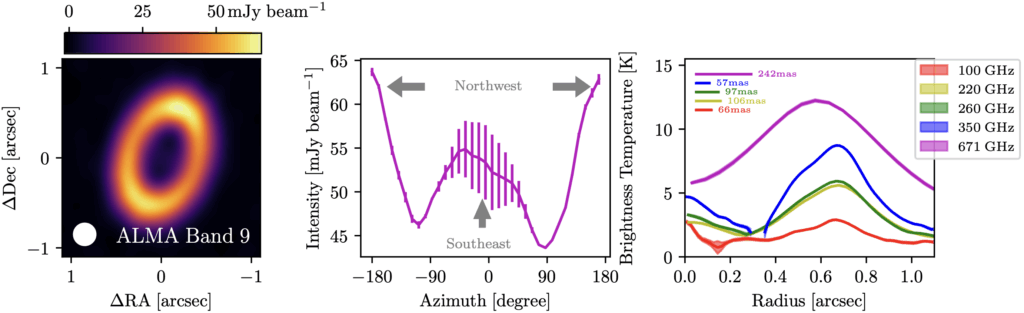
You can see one of the new ALMA images in the left side of Figure 1, and the intensity of the ring as a function of angle in the middle panel. The angular-average of the brightness is shown on the right, with the new ALMA observations in the highest-peaking purple curve. And there’s something suspicious about these new ones.
The new observations see a peak in their brightness closer to the star than every other ALMA observation. What the heck?!
It turns out that there might be a nice explanation for this. You remember I mentioned how gas and dust flow towards the star, with the dust drifting independently? Well, I kind of lied (sorry) – the tiniest grains actually follow the gas towards the star, like dust motes that float in the air in your bedroom, but the larger ones do drift independently. And since the gas can flow through the planet-induced gap we observe, then the tiniest grains should also pass through this gap whilst the bigger grains stay in the dust trap. Figure 2 shows the physics of what’s going on in this disc.

The authors believe that this is what they are seeing. The tiny dust grains, seen with these new observations, are closer to the star than the larger ones – so the dust trap, which prevents big dust from drifting, must be leaking. The big grains hang around at the dust trap for a long time, and as they do, they get stirred up by turbulence in the gas that makes them collide with each other and fragment into smaller particles. This turns some of the big grains into smaller ones that can leak through the gap! This has been theory for some time, and now we may have direct evidence of this phenomenon.
Okay, this is cool, but why does this actually matter? A dust trap is leaky, the planet isn’t doing its job at blocking dust, and someone should email the manufacturer with the warranty. So what?
It turns out that this ring isn’t the only place dust exists in PDS 70: there is some very close to the star, precisely where terrestrial, Earth-like planets may be forming (not seen in Fig. 1). A previous Astrobite discussed the detection of water in this region, and the water needs to be continually sourced from somewhere – either chemistry or drifting icy dust grains. Well, with this newfound evidence, we may have answered a piece of the puzzle: the dust grains can drift past the planet to this Earth-forming region!
Whilst we haven’t quite got the full instruction booklet on how the Solar System and Earth formed, today’s authors may have found one of the pages on how to transport water to Earth past a big planet like Jupiter – an important step towards understanding where life on Earth came from.
Astrobite edited by Magnus L’Argent.
Featured image credit: ALMA (ESO/NAOJ/NRAO)/Benisty et al.
