
Authors: Duncan Farrah, Kevin S. Croker, Gregory Tarle, Valerio Faraoni, Sara Petty, Jose Afonso, Nicolas Fernandez, Kurtis A. Nishimura, Chris Pearson, Lingyu Wang, Michael Zevin, David L Clements, Andreas Efstathiou, Evanthia Hatziminaoglou, Mark Lacy, Conor McPartland, Lura K Pitchford, Nobuyuki Sakai, and Joel Weiner
First Author’s Institution: Department of Physics and Astronomy, University of Hawai’i at Mānoa, 2505 Correa Road, Honolulu, HI, 96822, USA
Status: Published in ApJL [open access]
It’s been over two years since a group of researchers led by Duncan Farrah and Kevin Croker boldly suggested that black holes can explain the cosmological phenomenon known as dark energy by gaining mass as the universe expands. At the time, these suggestions provoked strong reactions within both the theoretical astrophysics community and within popular science media. Despite this, today these “cosmologically-coupled” black holes haven’t really caught on as a popular explanation for dark energy. In today’s somewhat extended bite we’ll trace the origins of this unconventional idea, explore the controversy surrounding both its theoretical and observational plausibility, and try to answer the question that I’m sure has been keeping you up at night for the past two years:
So… are black holes dark energy?
A Black Hole by Any Other Metric
To understand how we even got to the point of asking “are black holes dark energy?”, we need to take a step back and review some of the foundational concepts underpinning both black hole physics and cosmology: Einstein’s General Theory of Relativity (GR).
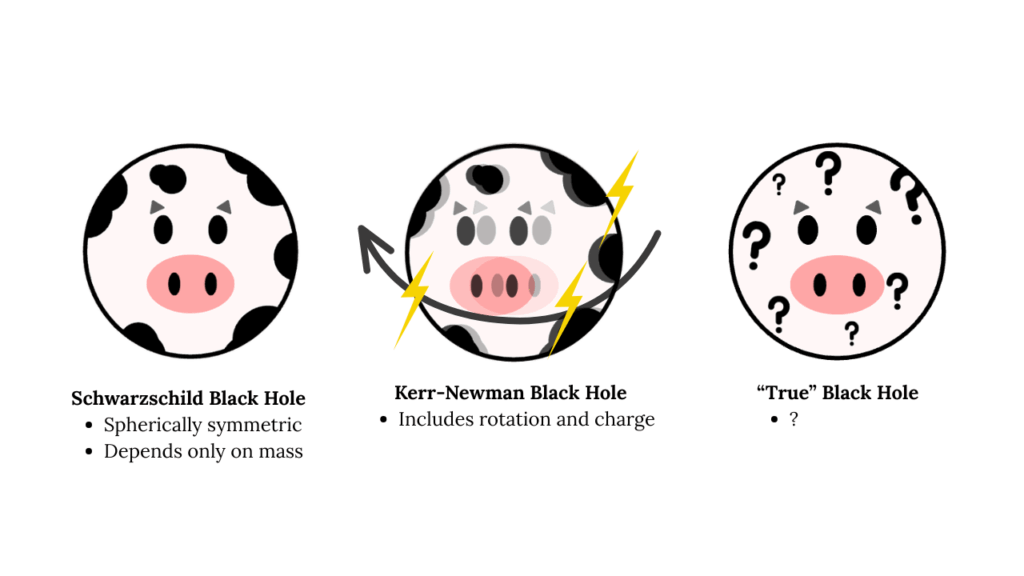
In general relativity, gravity is cast as a result of the geometry of spacetime itself: simply put, massive objects warp the spacetime around them, causing nearby bodies to travel along “curved” trajectories rather than straight ones. The warping caused by a specific configuration of matter is encoded in a mathematical object called the “metric”, which makes calculating this object an essential part of putting Einstein’s theory into practice. Unfortunately, finding the right metric—or even just the right way to write down the metric for a particular physical system—can be an extremely complicated endeavor. One of the earliest successful attempts at finding a metric that described something other than empty space was completed by Karl Schwarzschild in 1916. The metric he derived (the “Schwarzschild Metric”) described the geometry of spacetime around a spherically symmetric, uncharged, and non-rotating object. Basically, it’s the “spherical cow” solution for GR. Despite these idealizations, this solution to Einstein’s equations was important for providing one the first hints of the existence of singularities in GR, as well as the presence of event horizons—the somewhat terrifying surfaces-of-no-return that typically define the spatial extent of a black hole. Over the following decades, other physicists gradually extended Schwarzchild’s metric to account for less-idealized cases like rotating or electrically charged black holes (the… electrically-charged-and-spinning spherical cow solution?). With each further-refined solution, new and more bizarre features of black holes were discovered, including the existence of multiple distinct “horizons” and singularities spun out into extended “rings”.
The thing is, all of these fancier black hole metrics are still only approximate descriptions of the true spacetime structure around a black hole. In other words, they all still rely on making various simplifying assumptions that may not hold true in a real astrophysical environment. One of the assumptions made by most physicists when deriving a black hole metric, for example, is that far away from the event horizon the spacetime metric smoothly transitions back to boring-old empty-and-flat space. But in reality, the spacetime we live in is neither empty nor flat. For one, our universe is expanding. An expanding space like our own universe is typically described by what is known as the FLRW metric: in this metric, two points that start out at rest with respect to one another will over time appear to drift apart. So when we construct a black hole metric, in some sense it may be more accurate to seek out solutions that transition to FLRW at large distances. This is our first encounter with the general idea of “cosmological coupling”, as this idea suggests that the spacetime around a black hole should be “coupled” to what the cosmos is doing on much larger scales. What’s not yet obvious is whether this coupling would actually cause black holes to behave any differently than we previously thought.
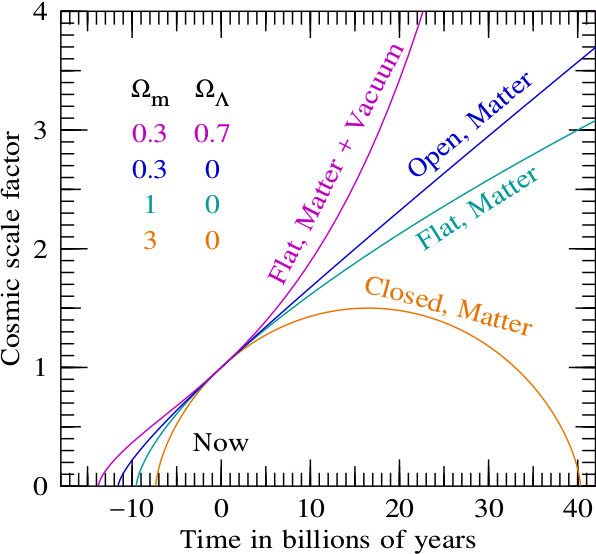
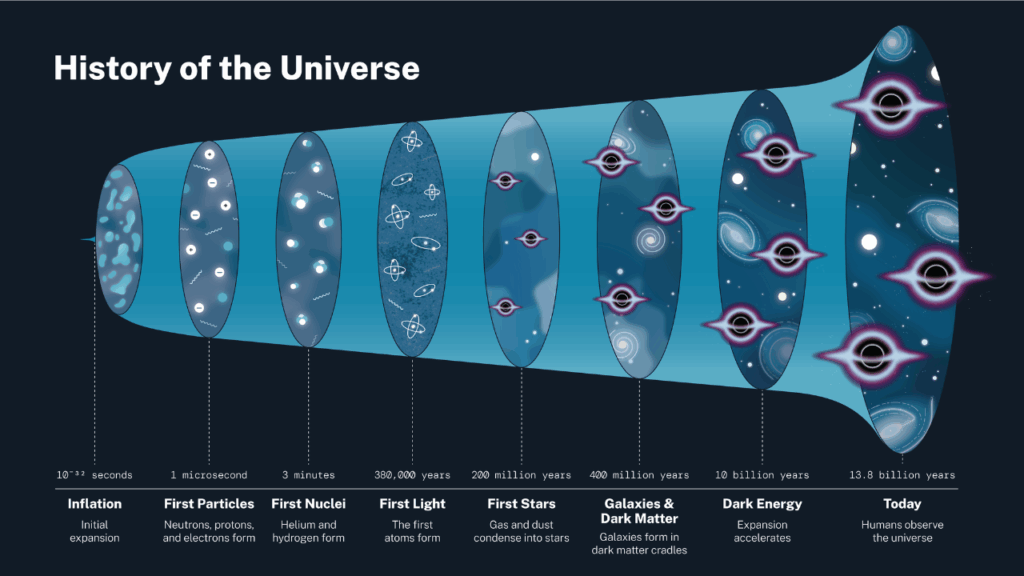
Before diving deeper into the details behind cosmologically coupled black hole metrics, we should quickly introduce the last theoretical ingredient that makes today’s paper extra spicy: dark energy. This form of energy is invoked to explain the curious observation that the universe is actually slightly accelerating in its rate of expansion. Because this expansion is driven by the evolution of the universe’s overall energy density, it can be determined by what forms of matter are present and in what ratios. For example, in an expanding universe dominated by highly relativistic particles (e.g. photons), the total energy density drops much quicker than in one dominated by slow-moving particles (e.g. protons, neutrons). Much of the expansion history of the universe can be well-explained by observed ratios of these various particle species—that is, until we try to understand the accelerated expansion of our recent universe. Luckily this acceleration can be accounted for by a simple addition to the cosmic recipe book: a new form of energy that stays constant in density. Some physicists believe this could be due to the energy of empty space itself—but any idea which accounts for some form of energy which grows at around the same rate the universe expands could theoretically fit the bill. So, back to those cosmologically coupled black holes…
Think Globally, Act Locally?
Attempts to “glue” local black hole spacetimes to cosmological ones are not new—the first such solution was found in 1933 by the British cosmologist George McVittie. In the over 90 years since McVittie’s metric, physicists have returned to the idea sporadically, and often without much fanfare. The lack of interest in these efforts outside of theoretical physics is not too surprising, as these solutions often either don’t change the expected behavior of black holes very much, or are produced specifically as toy models used to study theoretical aspects of GR.
The trail that leads us to today’s paper, however, began to really heat up in the later 2000s—in particular, the paper “Cosmological Expansion & Local Physics” by Valerio Faraoni and Audrey Jacques in 2007 helped put some more exotic black hole dynamics on solid theoretical footing. The problem they tackle in the paper is actually one that you might’ve come up with yourself when you first learned about the expansion of the universe: does the fact that the universe is expanding mean that I am too? In an undergraduate Intro to Cosmology course, you’ll typically hear that this is not the case because on small scales the gravitational attraction of matter greatly overpowers the universe’s expansion. Effectively, there is a decoupling of local physics from the dynamics of the greater universe. But the true story is unsurprisingly messier. This messiness comes from the fact that solving the equations at the heart of GR is hard, and sometimes even just knowing how to correctly set up what seems like a simple problem can take decades of work. In Faraoni and Jacques’ 2007 paper, the authors frame this question in terms of understanding the effects of cosmological expansion on several different black hole metrics, and surprisingly do find cases in which small-scale black hole dynamics seem coupled to broader cosmos. In particular, they find multiple black hole metrics whose horizons seem to expand in step with the universe as a whole. While this doesn’t mean your own body would expand in an inflating universe, it does provide a hint that cosmological dynamics on large scales could potentialy have counterintuitive effects on some small-scale systems.
This is the point at which our story takes a leap out of niche academic discourse and into the headlines. In 2019 Kevin Croker, along with several collaborators, examined these questions again, going back to basics. Specifically, they re-derived the fundamental equations governing the evolution of an expanding universe (the “Friedmann Equations”) from scratch. By taking a non-traditional approach to the derivation which they claim paid careful attention to some of the finer details involved in connecting small scales to large ones, Croker and his collaborators believe they again came to the conclusion that local physics—such as the quantity of mass or energy measured to be within some astrophysical system—can be dependent on the large-scale behavior of the universe. In particular, they found that for certain highly relativistic systems which mimic traditional black holes but contain pure vacuum energy in their interiors (for example “gravastars”—a story for another day) the mass, and therefore size of the object should grow as the universe expands. Broadly, they refer to this class of black-hole-mimicing relativistic objects as “Cosmologically-Coupled Compact Objects”, or C3Os.
Observing C3Os
At this point you may have noticed we’ve had to climb fairly far out on the limb of theoretical abstraction. Not only have we stretched our models of black hole space-times to their limits (quite literally), but in order to posit C3Os we’ve gone back to the roots of GR itself to try and unearth this counterintuitive coupling. If this has planted a seed of doubt in your mind, you’re in good company: in the years since, many experts in relativity have raised strong objections to Croker et al.’s claims. But this all truly came to a head with the publication of today’s paper in 2023, which, as its title suggests, makes the leap from theoretical claims about C3Os to observational ones.
In the paper, Duncan Farrah and Kevin Croker, along with over a dozen collaborators spell out the case for the black holes we observe in our own universe as behaving more like C3Os than traditional black hole models. In a prior study conducted by lead author Duncan Farrah, it was found that supermassive black holes (SMBHs) in a special class of galaxies known as red-sequence ellipticals had their masses grow by a factor of 8-20 times more than the increase in overall stellar mass between the younger and older galaxy samples. Because of the low expected rate of SMBHB accretion in this class of galaxies, Farrah noted in this study that the preferential black hole growth is difficult to fully account for with traditional galaxy and black hole evolution models.

You can probably see where this is heading: observing black holes growing at a much higher rate than expected leaves the door wide open for alternative models of black holes like gravastars or C3Os to swoop in and claim victory. In today’s paper, that is at least part of the story. The authors are able to very quickly craft an argument that this preferential SMBHB growth can be explained if the black holes are not described by your typical Schwarzschild or Kerr metric, but rather behave like the ever-expanding C3Os theorized in Kevin Croker’s earlier papers. In addition, the authors ascribe a value to the strength of the proposed cosmological coupling needed to account for the preferential growth—a parameter they denote as simply k. As it turns out, the k value which they found to best explain the red-sequence elliptical data was right around 3. This is a special value for C3Os, as it corresponds to objects which contain pure vacuum energy in their interiors, and which grow in mass at the same rate the universe’s volume increases. This lock-step expansion further implies that the total energy density of these objects within the universe should stay roughly constant throughout time. Ring any bells? The scenario in which the coupling parameter has a value of 0, which would be expected for a traditional black hole, was also found to be disfavored at a 99.98% confidence level. In short, the authors claim that not only are SMBHs growing more rapidly than expected across cosmic time, but they are gaining mass (and therefore energy) at right around the rate expected for a dark energy source.
But wait, there’s more! Not only do these observations align with the hypothesis that black holes are really dark-energy-like-C3Os, but the authors find that this interpretation can further account for all of the observed dark energy in our universe. Ultimately, this is what the hype was all about: with a simple tweak to the underlying physics of black holes, the authors’ model can explain preferential SMBH growth in red-sequence ellipticals, remove singularities from our interior descriptions of black holes, and account for all of the dark energy of our universe in one fell swoop! Unless…
Too Good to Be True?

As the saying goes, extraordinary claims require extraordinary evidence. Pushback against the paper’s claims came quickly from both theorists and observational astronomers. One of the most-cited and widely distributed “rebuttal” papers came from Carl Rodriguez, an assistant professor at UNC Chapel Hill who specializes in stellar dynamics and black hole formation. In Rodriguez’s paper, he invokes measurements of black holes in globular clusters. These clusters of stars are particularly relevant to the study of black hole evolution because they are known to contain some of the oldest stellar populations in our galaxy, and therefore some of the oldest black holes as well. If black holes in these systems are observed to have present-day masses that are not significantly larger than their mass at the time of formation, it would be a major strike against the cosmologically-coupled black holes hypothesis. This is in fact what Rodriguez found, using three black holes in globular cluster NGC 3201: the black holes are thought to be around 11.5 billion years old, but at present day they are likely to be only several solar masses each. If these black holes had a coupling strength k=3, they would have had to form from just a few solar masses of material, which is unlikely as current gravitational-wave measurements of black hole populations suggest a lower-limit for black holes of about 5.4 solar masses. Even granting the possibility of more extreme lower-limits around 2.2 solar masses, these black holes just don’t seem to be big enough to have grown at the rate suggested by Croker’s paper. After plugging in the appropriate caveats and statistical uncertainties, Rodriguez finds that a coupling strength greater than k=2 is ascribed only around a 1/2000 chance of fitting the data. Other observational studies have since found similar levels of disagreement with the k=3 measurement.
On the theoretical front, there remains skepticism and debate regarding the particular details of Kevin Croker’s prior derivation that re-ignited interest in cosmological coupling. Some physicists have tried to build off of these ideas, deriving additional dynamical effects that would be required in order to properly maintain energy conservation. Others have pushed back, arguing that their arguments lead to results that essentially violate basic physical laws, or even suffer from critical mathematical errors. In general, these complaints from theorists and the lack of studies observing rapid black hole growth in independent samples has put a slight damper on the whole cosmological-coupling conversation in recent years.
On the bright side, this paper has undoubtedly reignited some interest in the problem of embedding black holes in non-flat spacetimes and has added to the theoretical toolkit physicists and astronomers can pull from when trying to explain some of astrophysics’ biggest mysteries (several collaborators on the “Observational Evidence” paper recently put forth the argument that cosmological coupling can even explain the recent DESI results which suggested dark energy may be evolving over time). And of course the full scope of interesting ideas or insights that may result from efforts to rule out or strengthen the case for C3Os has yet to be seen. But unfortunately for you, the reader, the answer to the question that’s been plaguing you all these years—are black holes dark energy?—is:
Probably not. But… maybe?
Astrobite edited by Skylar Grayson
Featured image credit: NASA, modified by Lucas Brown
