
Title: The Flying Saucer edge-on disc’s Near Infrared silhouette revealed by the JWST JEDIce program
Authors: E. Dartois, J. A. Noble, J. B. Bergner, K. M. Pontoppidan, K. Assani, D. Harsono, M. K. McClure, J. C. Santos, W. E. Thompson, L. Welzel, N. Arulanantham, A. S. Booth, M. N. Drozdovskaya, Z. Li, J. Ma, L. Martinien, F. Ménard, K. Öberg, K. Stapelfeldt, Y. Yang
First-author institution: Institut des Sciences Moléculaires d’Orsay, CNRS, Univ. Paris-Saclay, 91405 Orsay, France
Status: Accepted in Astronomy & Astrophysics (Open Access)
Forming planets is pretty complicated, and a lot of models rely on several underlying assumptions about the physical structure of the host protoplanetary disc: how is their dust and gas distributed? What is their radius? What is their vertical structure?
Getting a grip on vertical structure is super important. It tells us how the dust in the disc is distributed by the turbulent motion of the gas, which is important in understanding disc evolution. Dust grains that are not stirred very high are said to be “settled”; these are typically larger grains > 10 micron in size. This is because the smaller dust grains follow the turbulent motion of the gas more, but larger grains don’t (think about kicking up tiny sand grains versus larger pebbles underwater).
The authors of today’s article have used data from the NIRSpec instrument on the James Webb Space Telescope (JWST) as part of the JEDIce program. The authors studied the protoplanetary disc known as the Flying Saucer and extracted information about the vertical structure of the dust. The Flying Saucer is especially interesting because it is ‘back-lit’ by an ambient emission region with Polycyclic Aromatic Hydrocarbons (PAHs). These PAHs are excited by ultraviolet photons and then emit infrared photons, which are later absorbed by the disc at specific wavelengths. As a result, the midplane of the disc – where most of the mass is, and where planets may be forming – is silhouetted in contrast to the upper layers (see Fig. 1 & 2). This lets the authors study the size of the disc in a new way.
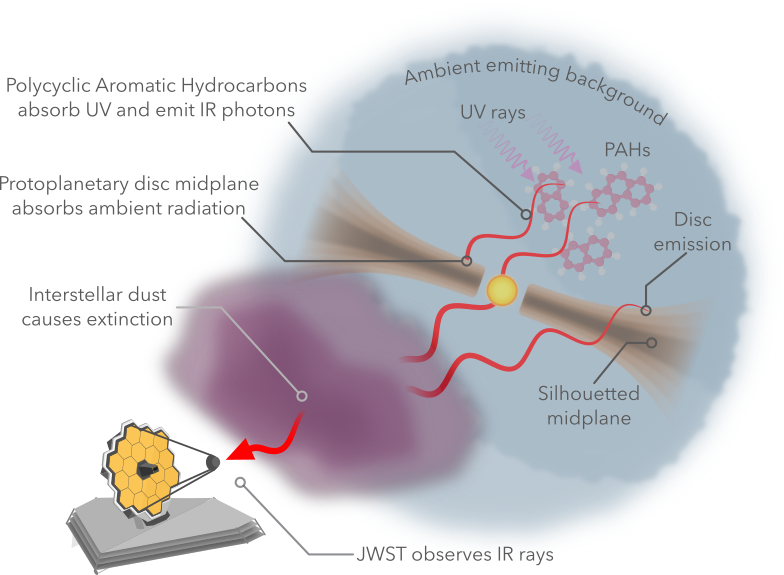

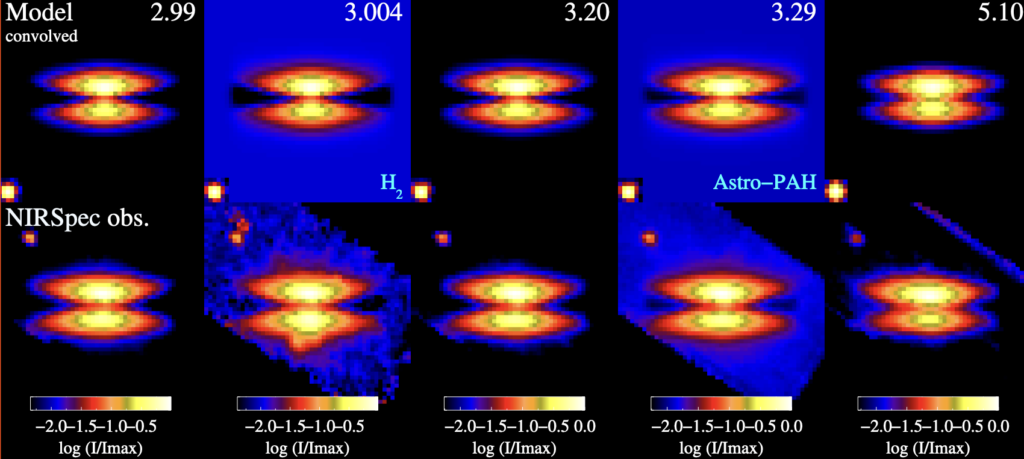
To study the disc, the authors created a model using the radiative transfer model RADMC3D, which simulates the path that light emitted from the disc takes to reach the observer (JWST in this case). They included the ambient emitting region, light from the star scattered off the disc, and a foreground cloud of dust to account for interstellar dust extinction; this is summarised in Figure 1. They then combined the model with the point-spread function of JWST (i.e. how the light from a point source spreads out due to JWST’s complex honeycomb-like mirror shape) and compared this to observations, which can be seen in Figure 3.
The authors found that the models matched the observations well, and they could therefore infer properties about the disc’s vertical structure. From both their models and the observations, they found a few key results.
The Flying Saucer… You’re shorter than I expected.
First, the disc has a radius of 235 au when looking at the small grains, which disagrees with the radius inferred from millimetre observations using the Atacama Large Millimeter Array (ALMA). Previous results found a radius of 190 au, but the authors highlight that the ALMA data traces larger, millimetre-sized grains, whereas the JWST data traces the micron-sized dust. The cause of this radius difference between dust sizes remains unclear, however.
Second, the authors discovered that the smaller grains are less settled than the larger, millimetre-sized grains. This matches well with expectations from theory, and the authors plan to conduct a follow-up study to fully analyse the disc structure and properties.
Finally, they found that the vertical extent of the small, icy grains is larger than expected. By balancing forces due to the disc’s gravity and gas pressure, we would expect the grains to reach a certain height above the midplane. The models suggest, however, that there ought to be a small fraction of ice-covered dust that is even higher up. The authors caution, however, that the model parameters could be degenerate (i.e. multiple different parameters give the same result, making it hard to distinguish which individual parameter is responsible for the results in real life).
The Flying Saucer provides a unique opportunity to study protoplanetary discs using the polycyclic aromatic hydrocarbon emission behind it; keep an eye out for the author’s follow-up study!
Astrobite edited by Mckenzie Ferrari.
Featured image credit: NASA/ESA/CSA, JWST, Francois Menard et al.; user Meli_thev on Wikimedia Commons
