

This guest post was written by Prajnadipt Ghosh (Prajna). Prajna is a PhD student in Astrophysics at the National Centre for Nuclear Research, Warsaw. He works on galaxy evolution, particularly focusing on low-surface-brightness galaxies and active galactic nuclei, from a multi-wavelength perspective. Outside of research, he enjoys traveling, cooking, watching sports, and anime.
Authors: Zichen Hua, Yu Rong, Huijie Hu
First Author’s Institution: University of Science and Technology of China, Hefei, China
Status: Published in MNRAS [open access]
Understanding how galaxies form and evolve is one of the biggest challenges in modern astrophysics. To tackle the problem, astronomers combine theoretical models built using computer simulations and semi-analytical techniques with real observations of the Universe. But for decades, the limited sensitivity of telescopes meant that the faintest galaxies remained hidden from our knowledge.
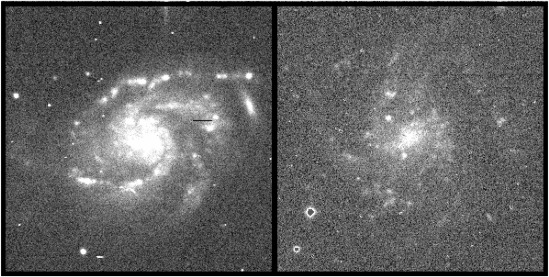
In the late 20th century, astronomers began discovering a class of extremely faint galaxies whose surface brightness, or brightness per unit surface area on the sky (often measured in magnitudes per square arcsecond), was much dimmer than previously known galaxies (see the difference between the two panels of Figure 1). These objects, now known as low-surface-brightness galaxies (LSBGs), are difficult to detect because they blend into the night sky. Thanks to modern, deep, and high-resolution surveys, such as those from the Hyper Suprime-Cam (HSC), many more of these elusive galaxies have now been revealed.
Surprisingly, simulations suggest that although LSBGs sit at the faint end of the galaxy luminosity function, they may play a disproportionately large role in the Universe. They appear to contribute significantly to the overall mass density present in the universe and the baryonic matter budget, suggesting that there may be more LSBGs than the brighter, more familiar high-surface-brightness galaxies (HSBGs). As a result, LSBGs are now recognized as essential pieces of the cosmic puzzle. Any complete theory of galaxy formation and evolution must include them to fully describe how the Universe came to look the way it does.
Astronomers have proposed several ideas to explain how LSBGs form. Some theories suggest they might be the remnants of failed galaxy mergers, while others argue they could arise in dark matter halos with unusually high spins, in low-density environments, or through extreme feedback processes. Despite these efforts, a definitive answer remains elusive.
In this study, the authors investigate LSBG formation using the Baryonic Tully-Fisher Relation (BTFR). This fundamental connection links a galaxy’s total baryonic mass (stars plus gas) to its rotational velocity. Within the standard cosmological framework, known as ΛCDM (read the Astrobites guide here), the BTFR reveals how a galaxy’s visible matter relates to the properties of its dark matter halo. For example, galaxies with a larger dark matter contribution relative to their baryonic mass tend to rotate faster for the same amount of visible matter, leading to a steeper BTFR, whereas galaxies with a smaller dark matter fraction would follow a shallower relation. At the same time, the BTFR has also been discussed in the context of alternative theories of gravity, such as modified Newtonian dynamics (MOND), making it a powerful tool for exploring both conventional and non-standard explanations for the formation of LSBGs.
To build a reliable sample, the authors first select LSBGs by choosing galaxies with central B-band brightness fainter than 22.5 mag/arcsec², based on data from the ALFALFA and SDSS surveys. They then apply several quality checks to ensure the galaxies have robust measurements. Galaxies that are viewed too face-on, have weak or messy hydrogen signals, or have nearby companions that might disturb their rotation are removed. They also exclude galaxies whose hydrogen signals have unusual shapes, making it difficult to measure their rotation speeds. After these steps, they end up with a clean set of 124 LSBGs. Using the same selection process, they also assemble a comparison sample of 210 HSBGs.
To place the galaxies on the baryonic Tully-Fisher relation, the authors first estimate how heavy each galaxy is and how fast it spins. They calculate the total “baryonic” mass by adding up the stars and the gas. The stellar mass is estimated from the galaxy’s brightness in the WISE W1 band, using a standard conversion. The amount of hydrogen is measured using the HI emission line and is converted to gas mass by adding the expected amount of helium from ΛCDM. To measure the rotation speed, they examine the width of the galaxy’s HI emission line in velocity space. Due to the Doppler effect, gas rotating toward us is blueshifted, while gas rotating away is redshifted, broadening the line. The broader the HI line, the higher the rotational velocity of the galaxy. The observed line width is then corrected for instrumental effects and redshift. Finally, they turn this width into a true circular velocity by accounting for the galaxy’s tilt.
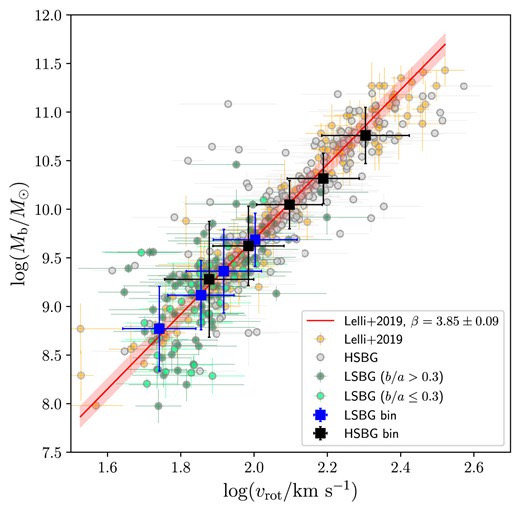
When the authors place both the LSBG and HSBG samples on the diagram (see Figure 2), they find that LSBGs follow the same BTFR as HSBGs, with similar slopes and normalizations. This means that, despite their extremely diffuse stellar distributions, LSBGs obey the same fundamental link between baryonic mass and rotation speed that characterizes normal spiral galaxies. Because they do not deviate from the BTFR, the faintness of LSBGs does not require unusual dark matter densities or extreme feedback processes.
Instead, the authors suggest that these galaxies are likely to form in dark matter haloes with higher-than-average spin, which naturally produce more extended and lower-density disks while still maintaining the usual baryon–halo connection. To ensure their results are not influenced by data quality or selection effects, the authors repeat the analysis by varying the filters employed during sample selection. In all cases, LSBGs remain consistent with the BTFR, reinforcing the conclusion that they are ordinary disk galaxies shaped primarily by the angular momentum of their haloes.
In conclusion, LSBGs are not exotic; rather, they are quiet, slowly evolving galaxies that follow the same fundamental rules as their brighter cousins.
Astrobite edited by Nathalie Korhonen Cuestas
Featured image credit: galaxy images from McGaugh (2021), edited by the author
