by Shannon Hall | Sep 8, 2013 | Daily Paper Summaries
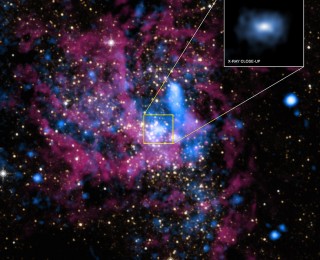
Sgr A* – the supermassive black hole sitting in the center of the Milky Way – is often referred to as a ‘starved’ black hole, meaning that it swallows very little of the nearby cosmic gas and dust. The authors of this paper observed Sgr A* with the Chandra X-ray telescope for 3 mega seconds, throughout which only 1% of the gas available to Sgr A* actually accreted onto the black hole. It swallows cold gas, while rejecting hot gas – ejecting the matter back into space.
by Kim Phifer | Aug 3, 2013 | Daily Paper Summaries
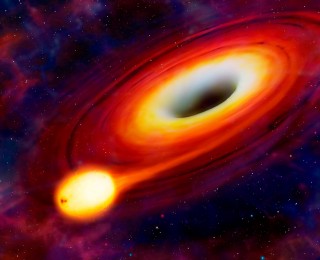
Maksym et al. investigate a possible tidal flare event in Abell 1795.
by Shannon Hall | Jul 18, 2013 | Daily Paper Summaries
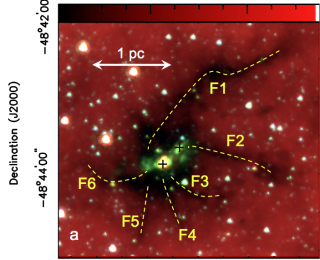
The formation of massive stars is still an intense topic of debate. Observations are difficult because massive star forming regions are heavily obscured by dust – invisible in the optical and near infrared. The trick is to look at much longer wavelengths. Today’s paper does just that, using the Atacama Large Millimeter Array (ALMA) in Chile to observe the birth of a massive star in submillimeter wavelengths. At 500 times the mass of the Sun and 1 million times brighter, it is the largest forming protostar ever seen in our galaxy.
by Betsy Mills | Jul 13, 2013 | Daily Paper Summaries
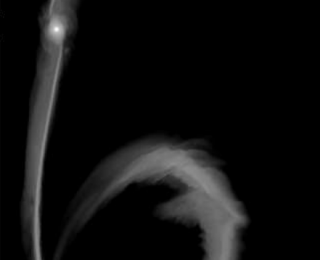
The authors of today’s paper investigate the feeding habits of the elusive quiescent supermassive black hole, finding that in addition to swallowing some stars whole and constantly snacking on the winds of other stars, some black holes may also dine on giant stars slowly disrupted over tens to hundreds of orbits.
by Erika Nesvold | May 30, 2013 | Daily Paper Summaries
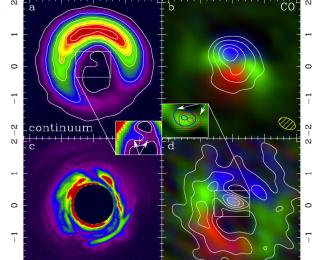
There’s a lot going on in the HD 142527 protoplanetary disk — accretion, gap opening, and a horseshoe-shaped dust ring. The authors of this paper used ALMA to take a closer look at the gas and dust in this busy disk.
by Anna Rosen | Apr 25, 2013 | Daily Paper Summaries
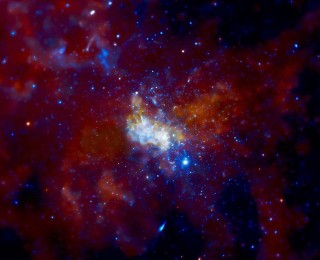
In this paper, the authors use near-IR imaging and spectroscopy to determine if G2, a galactic center source about to approach our galaxy’s supermassive black hole, is a gas cloud or a star.
