by Evan Schneider | Oct 3, 2012 | Daily Paper Summaries
We know most galaxies host supermassive black holes at their centers, but how do they get so big? In this study, the authors investigate one of the smallest known supermassive black holes (weighing in at only 100,000 solar masses), to shed some light on what a young, accreting black hole might look like.
by Adele Plunkett | Sep 14, 2012 | Daily Paper Summaries
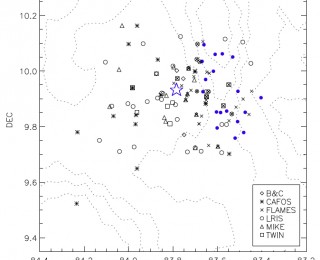
A wealth of observations tell an active accretion story within the Lambda Orionis Star Forming Region, at the head of the Orion constellation.
by Ryan Foltz | Sep 10, 2012 | Daily Paper Summaries
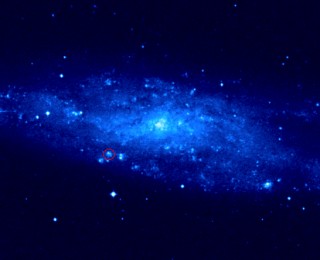
Does the existence of mysterious, ultra-luminous X-ray sources indicate that black holes may become more massive than previously thought?
by Susanna Kohler | Sep 7, 2012 | Daily Paper Summaries
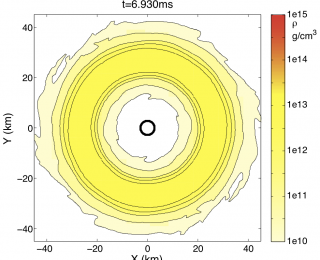
What happens when a neutron star collapses into a black hole? What kind of signal could we expect to see? These theorists have some ideas…
by Justin Vasel | Aug 10, 2012 | Daily Paper Summaries
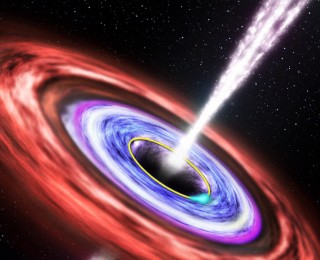
If there was a cosmic play with the universe as its stage and the celestial bodies as its actors, undoubtedly there would be one character more notorious than the rest; a villain feared by all: the infamous Black Hole. They are truly the things of nightmares, and for one little star out there, that nightmare came true.
by Alice Olmstead | Jul 31, 2012 | Daily Paper Summaries
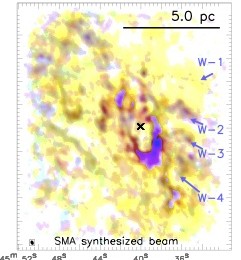
Recent studies have revealed a surprising amount of activity happening in the heart of our own Milky Way. In this paper, Liu et al. explore the kinematics of the gas outside the most central regions of our galaxy, and reveal that the Galactic center is being fed even more material from the main structure of the Milky Way.
