A Planetary Death Census
Planets are occasionally found swallowed by their dying host stars. Where and how often does this happen?

Planets are occasionally found swallowed by their dying host stars. Where and how often does this happen?
Radiation from massive stars can melt away protoplanetary disks. What can the leftover disks tell us about the environment from which they formed?
Today’s post presents SIMBA, a cosmological simulation that focuses on understanding the growth and evolution of black holes and their host galaxy.
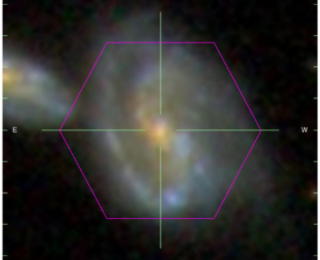
Observations from the MaNGA survey help to answer the question: What are the features of a galaxy that appears to have undergone recent gas accretion?
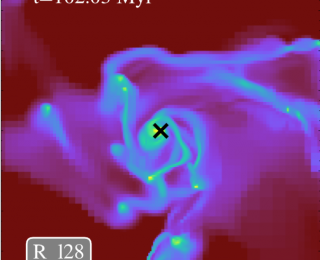
Do we really understand how black holes grow? Using new methods to run high resolution simulations, the authors of this paper investigate the evolution of gas near a supermassive black hole – and their results have serious implications for the models commonly used in cosmological simulations.

Some galaxies live peaceful lives, calmly making stars at a sedate pace, with supermassive black holes that don’t vomit jets of material. Other galaxies… not so much. Come to Professor Julie Comerford’s upcoming #AAS232 talk to learn more about the weird and wonderful world of active galactic nuclei!