by David Wilson | Sep 28, 2015 | Daily Paper Summaries
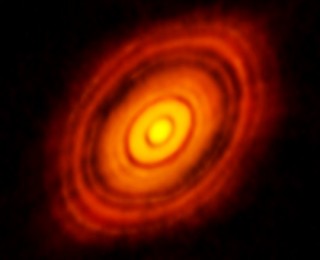
Nearly a year ago, the ALMA collaboration released this stunning image of the young star HL Tau. The sub-millimeter wavelengths of light that ALMA detects revealed a vast disc of gas and dust, several times larger than Neptune’s orbit. Intriguingly, the disc was divided up into a series of well-defined, concentric rings.
The cause of the rings seemed clear: There must be planets around HL Tau, their gravity sculpting the gas and sweeping out the dark gaps in the disc.
by Ben Montet | May 31, 2013 | Daily Paper Summaries
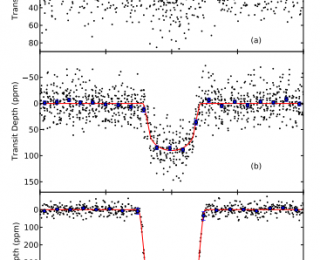
Barclay et al. find a “candidate” planet smaller than Mercury in the Kepler data…will it pass their tests and be confirmed as the smallest known planet?
by Caroline Morley | Mar 15, 2013 | Daily Paper Summaries
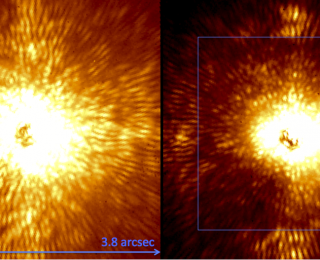
Two years ago this month, I wrote my very first astrobite about the puzzlingly cloudy atmosphere of the outermost planet, HR 8799b; today I’m revisiting the system and looking at a recent paper which measured spectra of not just one planet, but the entire planetary system. This is the first comparative spectroscopic study of any multi-planet system (other than our own Solar System of course).
