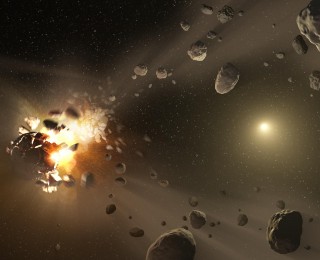
Ripping Apart Asteroids to Account for Earth’s Strangeness
Earth’s composition seemingly does not fit into planet formation theory. Ripping apart its building blocks by collisions during accretion might sound violent, but can be a way to go.

Earth’s composition seemingly does not fit into planet formation theory. Ripping apart its building blocks by collisions during accretion might sound violent, but can be a way to go.
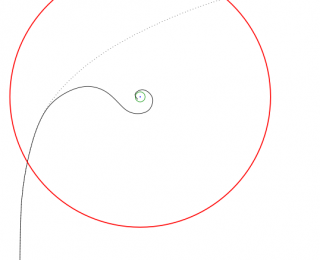
A model that needs fewest parameters to explain a scenario is favourable. The fact that mm-size dust grains (chondrules) are present in the entire solar system brings rise to the question, whether all bigger solid objects are a collection of chondrules.
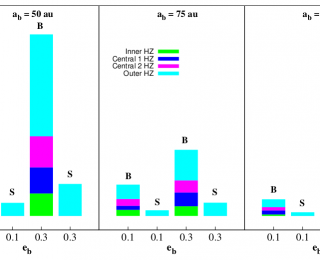
Planets in binary star systems can receive a sizable amount of water from asteroids getting perturbed out of their orbits
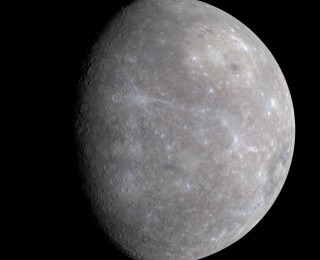
Mercury is the smallest planet in the Solar System, but some of its properties are a big challenge to explain. Today’s Astrobite presents a solution to one of these issues: The darkening of Mercury is induced by a high abundance of carbon delivered by meteorites.
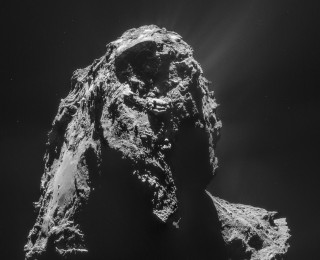
The years of 2014 and 2015 may well be known as the time when our exploration of the solar system truly took off, as we explored asteroids, comets, and minor planets. Here’s a look back at what we’ve accomplished in the last year, and what we’re about to achieve in the year to come.

Chondrules are among the oldest components of the solar system and give insight in the solar system’s earliest phase. But how are they formed? In shocks? That seems to be at least difficult.