• RSS
  • Submit a Guest Post
  • Undergraduates: Submit your Research!
  • Suggest a Paper Topic!
astrobites
  • About
    • About Astrobites
    • Meet the Authors
    • Statement of Inclusivity
    • Copyright & Permissions
  • Latest Research
    • Daily Paper Summaries
    • Classics
    • Undergrad Research
    • Physical Review Coverage
  • Beyond astro-ph
    • Beyond astro-ph Library
    • Interviews
    • Career Navigation
    • Personal Experiences
    • Current Events
    • Teaching with Astrobites
  • Guides
    • EM Spectrum
    • Galaxies & AGNs
    • Spectroscopy and Spectral Lines
    • Adaptive Optics
    • Gravitational Waves
    • Transient Astronomy
    • Astrophysical Software
    • Graduate School
    • Writing a personal statement for grad apps
    • First Observing Run
    • …More Guides!
Select Page
Most Asteroids are Not in the Asteroid Belt

Most Asteroids are Not in the Asteroid Belt

by Nick Ballering | Nov 10, 2014 | Daily Paper Summaries

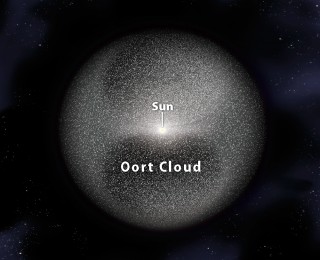
Simulations show that the Oort cloud contains eight billion asteroids (in addition to hundreds of billions of comets). Do these asteroids pose a threat to Earth?

Albedo as a quick proxy for asteroid compositions

Albedo as a quick proxy for asteroid compositions

by Joseph O'Rourke | Jun 26, 2014 | Daily Paper Summaries

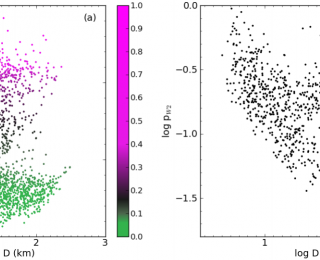
Obtaining high-resolution spectra of asteroids is challenging. Measuring asteroid albedos in broad photometric wavebands is relatively easy, and potentially provides useful information about surface composition.
Water vapor found on dwarf planet Ceres

Water vapor found on dwarf planet Ceres

by Jessica Donaldson | Jan 28, 2014 | Daily Paper Summaries

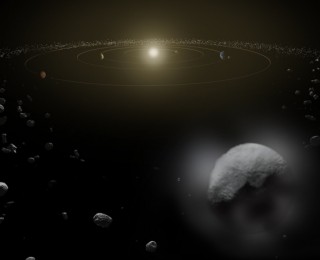
Large plumes of water vapor were recently found on the dwarf planet Ceres in the asteroid belt. Using Ceres’ rotation, astronomers have located two possible sources for the water vapor on the surface.
Water found in remains of planetary system around a white dwarf

Water found in remains of planetary system around a white dwarf

by Jessica Donaldson | Oct 30, 2013 | Daily Paper Summaries

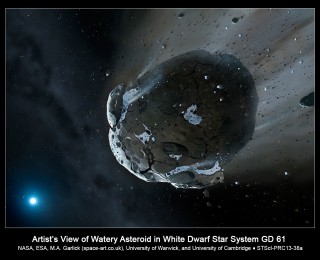
Astronomers have found evidence of water in the remains of a planetary system around a white dwarf. This indicates water-rich asteroids can bring water to terrestrial planets, important for the habitability of planets.
What’s Next For Kepler?

What’s Next For Kepler?

by Nick Ballering | Sep 9, 2013 | Current Events

NASA is looking for a new mission for the damaged Kepler space telescope. Here are some ideas.
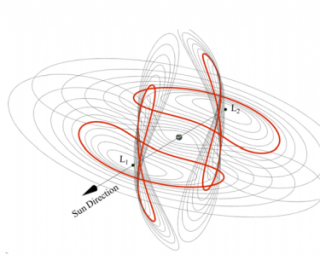
How to Drag an Asteroid to Earth

How to Drag an Asteroid to Earth

by Justin Vasel | Aug 14, 2013 | Daily Paper Summaries

With some assistance from gravity, it is possible with currently-available technologies to bring small asteroids into orbit next to Earth to be studied and mined.

« Older Entries
Next Entries »

Loading

Follow our socials

  • Bluesky
  • Facebook
  • Instagram
  • RSS Feed

More Posts About

AAS AGN astronomy astrophysics binary stars black holes cosmology dark matter dwarf galaxies exoplanets galaxies galaxy evolution gravitational waves habitability JWST Kepler Milky Way observations planetary science planet formation protoplanetary disks radio astronomy simulations solar system spectroscopy star formation stars stellar evolution supernovae theory

Posts by Category

  • Accessibility
  • Applications
  • Beyond
  • Book Reviews
  • Career Navigation
  • Classics
  • Climate Change
  • Course Assignments
  • Crossposts
  • Current Events
  • Daily Paper Summaries
  • Game Reviews
  • Guides
  • Historical Astronomy
  • Instrumentation
  • Interviews
  • Outreach
  • Personal Experiences
  • PRJ
  • Quick Notes
  • Satellites
  • Teaching
  • Undergraduate Research

More Astronomy

  • AAS
  • AAS Nova
  • astro-ph
  • AstroBetter
  • APOD

Read Astrobites in Other Languages

  • Astrobitos (Spanish)
  • Astropontos (Portuguese)
  • staryab (Farsi)

Listen to Astrobites

  • astro[sound]bites

Discover More Incredible Science

  • ScienceBites Network
  • RSS

© 2026 Astrobites | All Rights Reserved | Supported by AAS | Designed by Elegant Themes | Powered by WordPress