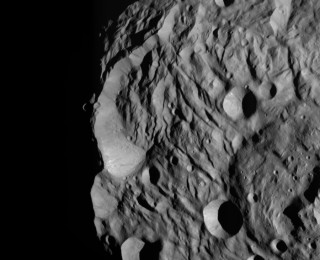
by Elizabeth Lovegrove | Apr 29, 2012 | Current Events, Guides
A coalition of willing billionaires, spaceflight professionals, and scientific advisors under the banner of Planetary Resources have announced their intention to go out there and mine themselves some asteroids. Are they serious? What’s going to happen? What does it mean for astronomers and planetary scientists? What contributions will the scientific community make, and what data do we stand to gain?
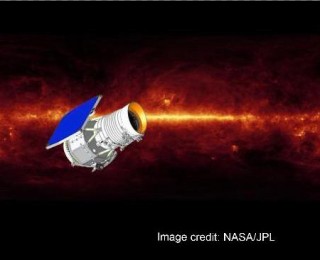
by Kim Phifer | Mar 19, 2012 | Current Events, Guides
The Wide-field Infrared Survey Explorer (WISE) data release promises many new and exciting discoveries!
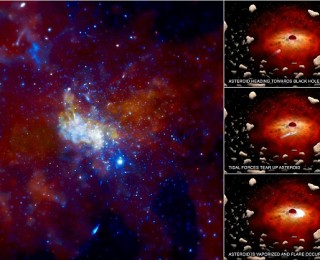
by Susanna Kohler | Feb 10, 2012 | Daily Paper Summaries
Small daily flares are observed from the black hole in the center of our galaxy. The authors of this paper propose the flares are due to Sgr A* frequently snacking on asteroids!
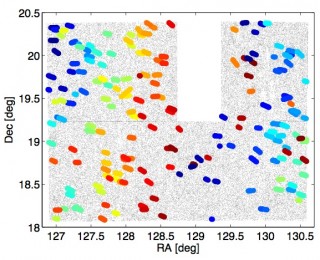
by Elisabeth Newton | Jan 18, 2012 | Daily Paper Summaries
Title: Asteroid rotation periods from the Palomar Transient Factory survey Authors: D. Polishook, E. O. Ofek, A. Waszczak, S. R. Kulkarni, A. Gal-Yam, O. Aharonson, R. Laher, J. Surace, C. Klein, J. Bloom, N. Brosch, D. Prialnik, C. Grillmair et al. First Author’s Institution: Benoziyo Center for Astrophysics, Weizmann Institute of Science, IsraelDetermination of the rotation periods of asteroids has a number of applications. When considering an asteroid individually, it can help one to understand the physical properties of an individual asteroid, including its shape and whether or not it’s a binary. In a statistical sense, the rotations of the entire population of asteroids can help one to understand the physical processes that govern asteroid rotation. The two mechanisms that influence an asteroid’s rotatation are collisions and something called the YORP effect, in which photons from the Sun are actually able to accelerate asteroids through absorption and re-emission. There’s a nice discussion of this type of science which includes a description of the YORP effect in this Cornell press release, while this Discovery news story reports on the first direct detection of the YORP effect (which combines the initials of four different people).*Currently there are 3,700 asteroids with measured rotation periods; using the Palomar Transient Factory, these authors aim to eventually measure rotation periods for 10,000 asteroids. (PTF also finds supernovae, see for example this discovery). In this paper, Polishook et al. report on the identification of 624 asteroids in the PTF survey, 20% of which are new discoveries, and 88 new rotation period measurements. All of the asteroids identified belong to the main asteroid belt. The smallest asteroids...
by Kirit Karkare | Jan 5, 2012 | Daily Paper Summaries
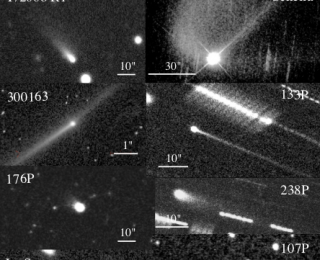
What happens when something looks like a comet but orbits like an asteroid?
by Caroline Morley | Nov 8, 2011 | Daily Paper Summaries
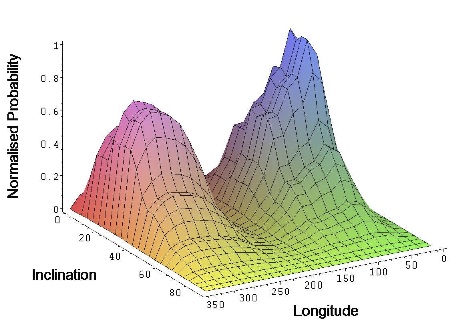
One of the many cool observations that have come from the WISE telescope survey this year has been the discovery of the first Trojan asteroid orbiting at the same semi-major axis as the Earth. The authors of this paper outline a way to optimize future surveys to find more of these Earth Trojans.
