by Josh Fuchs | Apr 18, 2013 | Daily Paper Summaries
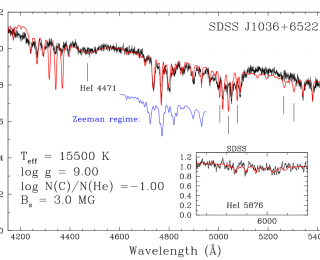
The authors present the discovery of a new hot carbon-atmosphere white dwarf with a strong magnetic field. This discovery might help illuminate the origins of a recently found class of white dwarfs.
by Elisabeth Newton | Nov 29, 2012 | Daily Paper Summaries
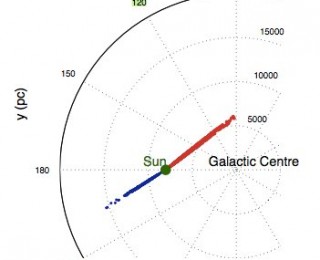
“Galactic archaeology” is the term that has come to refer to using the motions and chemical compositions of stars of different ages to learn about the history of the Milky Way. It seems to me that “galactic paleontology” might be a bit more accurate. I hope to see galactic archaeology v. galactic paleontology fought out in the comments!
by Lauren Weiss | Oct 21, 2012 | Daily Paper Summaries
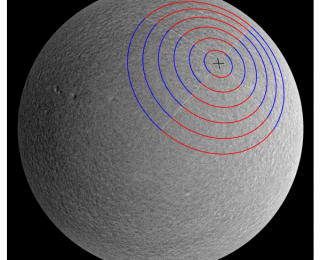
In the sun, subsurface flows are 20-100 times slower than what is predicted in widely used theoretical models.
by Elisabeth Newton | Apr 11, 2012 | Daily Paper Summaries
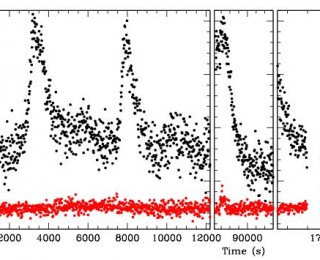
Title: SDSS J184037.78+642312.3: The First Pulsating Extremely Low Mass White Dwarf Authors: J. J. Hermes, M. H. Montgomery, D. E. Winget, Warren R. Brown, Mukremin Kilic, Scott J. Kenyon First Author’s Institution: UT Austin, TX97% of all stars — those with initial masses less than about 8 solar masses — end their lives as white dwarfs (WDs), hot objects with roughly the mass of the Sun but with the radius of the Earth. They have virtually no internal source of energy and so simply cool with time. Some of the coolest white dwarfs have been around for quite a while and are probes of conditions in the early Universe. They are also tracers of galaxy evolution and can be used to date stellar populations. Understanding their nature is key if we are to use white dwarfs for these purposes.Asteroseismology of pulsating white dwarfs is one way to learn about the interior structure of these fascinating objects. Asteroseismologists use stellar vibrations in much the same way as seismologists use earthquakes to study Earth’s interior (see this astrobite and this one). The authors of this paper are on a hunt for DAV WDs. For those of us who don’t speak white dwarf lingo, that’s a white dwarf (“D”) with a hydrogen atmosphere (the “A” subclass) that pulsates (“V” for variable). There are actually quite a few of these DAV WDs, but the 150 we know of are fairly massive for white dwarfs, with masses between 0.5 and 1.1 solar, and are believed to have carbon-oxygen cores. These authors are after a rarer beast: a pulsating helium-core white dwarf, which would have...
by Guest | Dec 12, 2011 | Daily Paper Summaries
Just as seismologists determine the structure of the Earth through surface vibrations, so asteroseismologists do the same for stars
by Elisabeth Newton | Aug 17, 2011 | Daily Paper Summaries
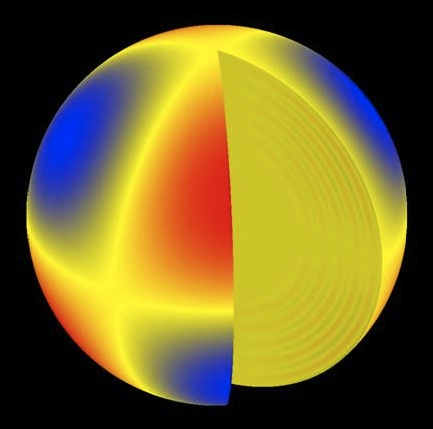
If there’s one type of star you’d think astronomers would know a lot about, it’s probably solar-type stars. After all, humans have been staring at our very near neighbor for millennia and in the recent century have dedicated entire space missions to studying this archetype. But there is always more to be learned and new tools like asteroseismology continue to open up avenues of study previously closed.
