by Kirit Karkare | Apr 24, 2012 | Daily Paper Summaries
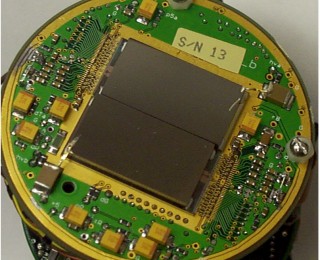
Why are there so few X-ray imaging polarimeters? This paper determines the intrinsic sensitivity of stacked imaging detectors to hard X-ray polarization.

by Kirit Karkare | Feb 28, 2012 | Daily Paper Summaries
A new infrared camera is now flying 41,000 feet above the Earth’s surface!
by Shannon Hall | Feb 12, 2012 | Daily Paper Summaries
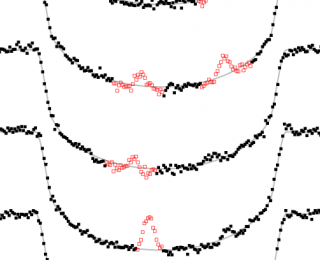
This paper discusses the observed anomalies caused by starspot occultations due to transiting exoplanets. They are useful in determining the obliquity of the star with respect to the orbital plane of the transiting planet.
by Dan Gifford | Jan 24, 2012 | Daily Paper Summaries
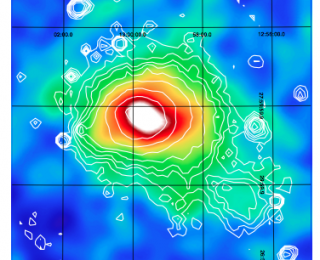
Estimating galaxy cluster masses is difficult, but it might be getting more precise thanks to the Sunyaev-Zeldovich effect.
by Lucia Morganti | Dec 16, 2011 | Daily Paper Summaries
Title: Two ten-billion-solar-mass black holes at the centres of giant elliptical galaxies Authors: Nicholas J. McConnell, Chung-Pei Ma, Karl Gebhardt, Shelley A. Wright, Jeremy D. Murphy, Tod R. Lauer, James R. Graham, Douglas O. Richstone First Author’s Institution: Department of Astronomy, University of California, Berkeley This Nature letter reports on a recent discovery that has also met with great interest in the popular press: astronomers have measured the biggest black holes ever! These two ten-billion-solar mass giants are significantly more massive than any other known black hole and more massive than predicted with the widely-used correlations relating the black hole mass to other properties of the host galaxy.First, a bit of context. Black holes are extremely compact concentrations of matter producing such strong gravitational pull that nothing, not even light, can escape. General relativity predicts such gravitational singularities of zero volume and thus infinite density. Studying stellar evolution, we learn that the explosions of heavy stars as supernovae can leave behind remnants of stellar mass-black holes. But super-sized black holes of million solar masses (called supermassive black holes) presumably originate from mergers of other black holes, or by accreting large amounts of stars and gas in an active galactic nuclei (AGN) phase.Nowadays astronomers believe that every galaxy harbours a supermassive black hole at its center, including our own Milky Way where a central mass concentration of four million solar masses has been deduced from 16-years monitoring of stellar proper motions (see also today’s astrobite on the amazing discovery of a huge gas cloud being swallowed by this black hole). As pointed out by Susanna’s astrobite, it is not possible...
by Ian Czekala | Dec 15, 2011 | Daily Paper Summaries
Sounds like a simple question. When you go out and look at the stars at night with your naked eye, you might be able to pretty easily sort out which stars are the brightest, which are the faintest, and come up with some ranking of them for those in between. Now, do this with telescopes…
