by Shang-Min Tsai | Feb 21, 2017 | Daily Paper Summaries
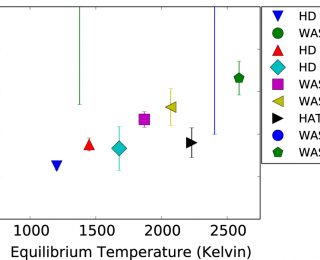
Hot Jupiters, on the other hand, are extreme worlds. They orbit very close to their host stars (< 0.1 AU) and are locked by the tidal force into synchronous rotation, always having the same side facing their stars. This makes for interesting atmospheric dynamics. In today’s paper, we take a look into these exotic worlds. The authors examined what essentially controls the day-night temperature differences and compare their theory to numerical simulations (so called general circulation models or GCM).

by Matthew Green | Sep 16, 2016 | Daily Paper Summaries
Planets form with molten surfaces; but how does this ocean of magma affect the planet’s atmosphere?
by Korey Haynes | Apr 25, 2014 | Daily Paper Summaries
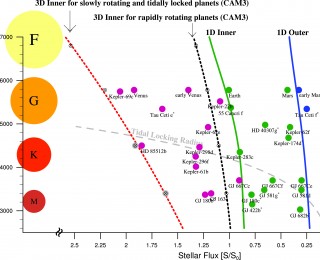
Find out how cloudy atmospheres can improve the chances for habitability in close-in planets.
by Erika Nesvold | Feb 7, 2013 | Daily Paper Summaries
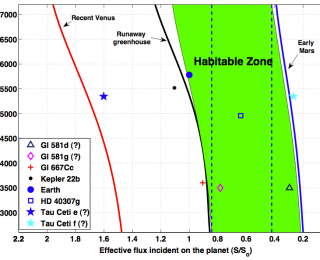
In our search for life on other planets, we begin by determining which exoplanets orbit in the habitable zone of their star. But where exactly is the habitable zone for a given star? The authors of this paper update a previous planetary climate model to predict where you should looking for your next extrasolar vacation home.
by Caroline Morley | Feb 28, 2012 | Daily Paper Summaries
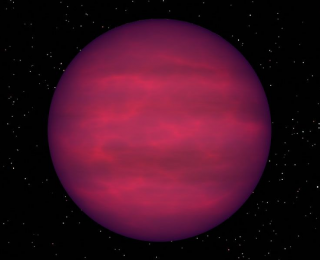
This paper describes an incredibly variable brown dwarf. To fit this variability with models, a combination of thick clouds and clearer areas are needed. This means that there are big dusty storms that cover large fractions of 2M2139’s surface!
by Nathan Goldbaum | Aug 27, 2011 | Daily Paper Summaries
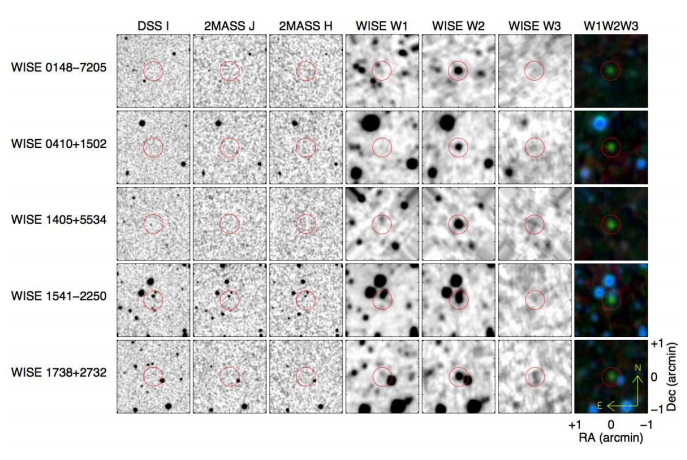
Today we will be discussing an exciting discovery – the first observations of an entirely new spectral class of stellar objects!
