When Two Black Holes Become One…
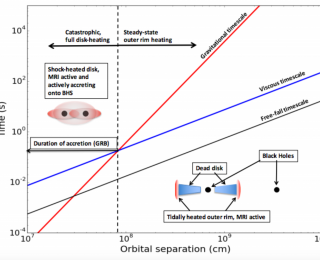
The recent LIGO announcement has lead to exciting waves of new science. Today, we look at one theory about the potential gamma-ray burst associated with a gravitational wave.

The recent LIGO announcement has lead to exciting waves of new science. Today, we look at one theory about the potential gamma-ray burst associated with a gravitational wave.
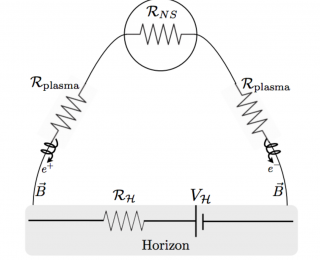
Some fast radio bursts might be the result of a black hole lighting up a neutron star.
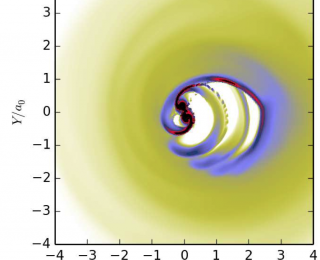
Quasar PSO J334.2028+01.4075 has a very healthy heart rate of 6.7 beats per decade, or once every 542 days. One explanation is that this guy hosts a pair of supermassive black holes. If true, then the astonishing interpretation of this quasar’s heart rate is that its black holes are only a few orbits away from merging!
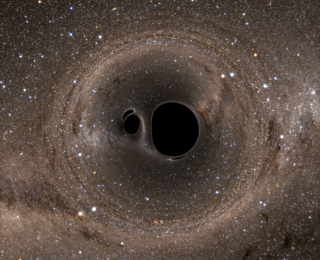
What kind of lens is a BBH merger? These authors present the first pictures of light sources lensed by numerical models of BBH mergers.
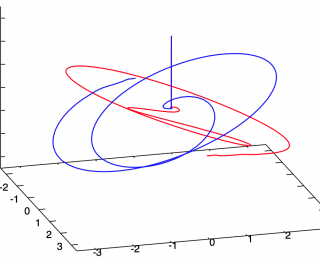
Imagine a spinning skater. She pulls her arms in a little and spins faster. She brings her arms all the way into her chest, and spins really fast, and then bam! she rockets up into the sky. Seven years ago, computer simulations revealed a configuration of two spinning black holes that merged in this way, jumping out of their orbital plane with a velocity of several thousand km/s. Not only is this weird, it’s also important. We know that large galaxies host supermassive black holes at their centers. We also know that galaxies merge, presumably introducing their black holes to one another. If the newly formed black hole were to exit the galaxy entirely, it could carry its accretion disk with it, and be observable as a displaced core.
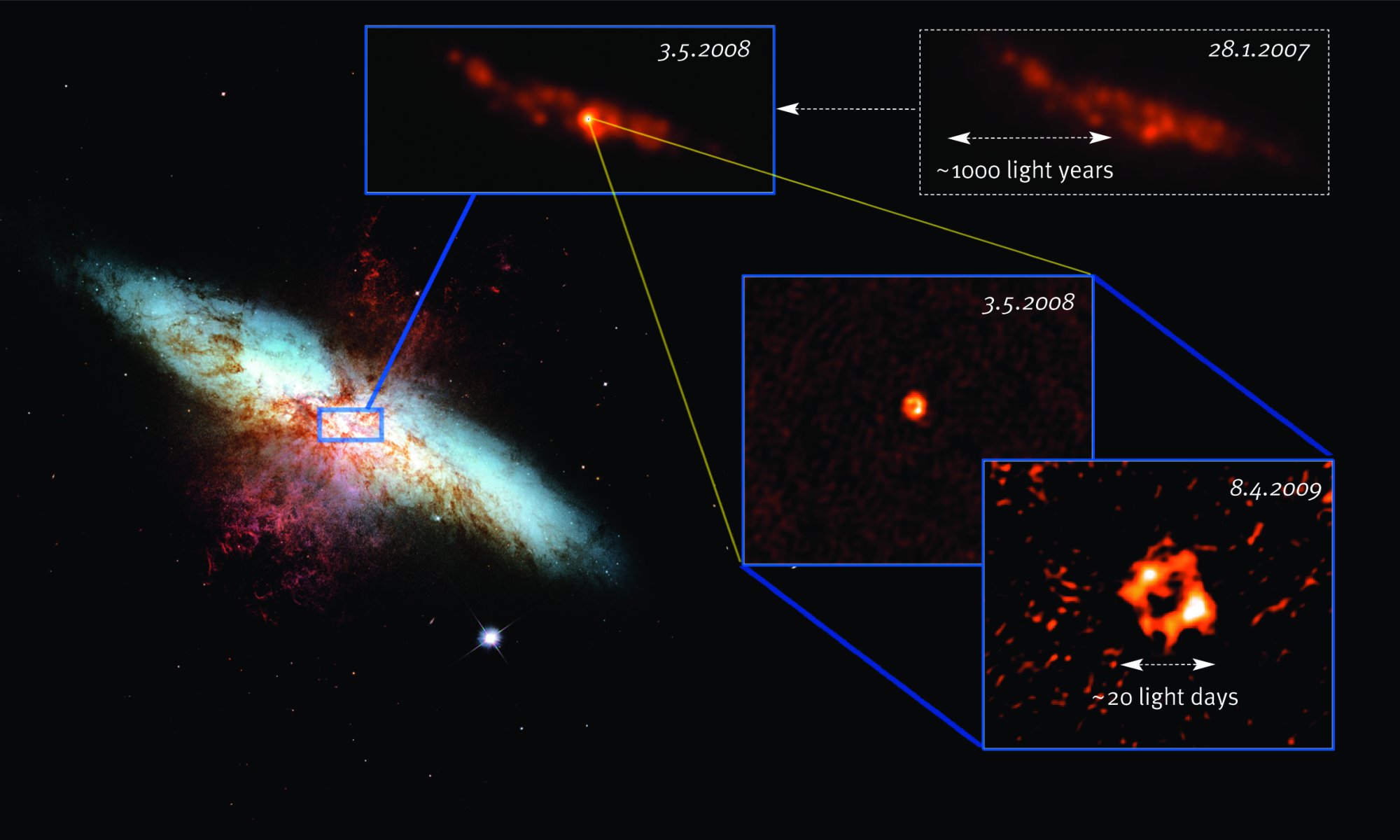
The recent discovery of a radio transient in the nucleus of the galaxy M82 has left scientists guessing as to what it might be. In this paper the authors examine the possibility that it’s a microquasar just like SS433 — but located outside of our galaxy!