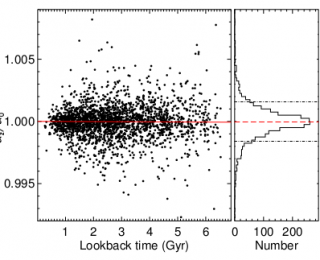
Constraining fine-structure constant variations using QSOs
From measurements of quasar spectra, we can determine whether or not the fine structure constant is really a constant.

From measurements of quasar spectra, we can determine whether or not the fine structure constant is really a constant.
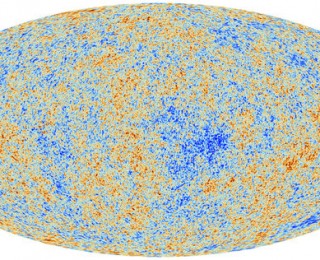
The primordial seeds of the Universe, the Cosmic Microwave Background, have been measured by the Planck satellite with unprecedented precision. In this post, we summarize some of their results on cosmological parameters and primordial non-gaussianity.
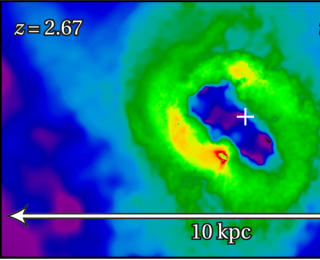
What were astronomers reading and talking about in their research last year? Check out figures from the top 12 most-cited astronomy papers from 2012 (so far) and find out what researchers were up to and why!

I’m spending the next month working on a telescope at the South Pole. In this first installment, I check out New Zealand and get my Extreme Cold Weather gear!
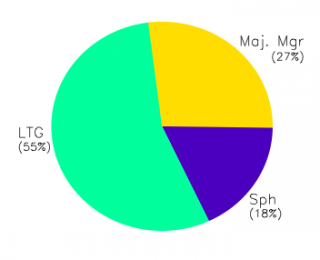
In this study, Kaviraj et al. find that major mergers only contribute a small percentage (17-27%) of the total star formation at a redshift of 2, when the Universe was 3.3 billion years old and vigorously creating new stars. This goes against what we once thought, and leaves the door open for other mechanisms to drive the global star formation rate in the early Universe.
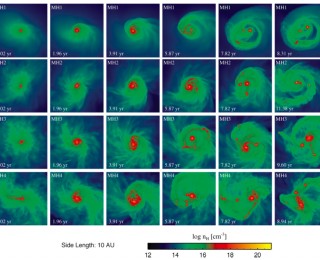
In a recent paper, Stacy et al. reveal the detailed internal structure of the seeds of four of the first stars, and demonstrate for the first time that they are rapidly spinning throughout. Their results bring us one step closer to a coherent story of the lives and deaths of Population III stars.