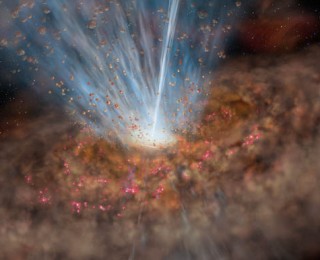
by Shannon Hall | Sep 16, 2012 | Daily Paper Summaries
In the nearby Universe, massive galaxies contain very little interstellar gas and old stellar populations. But theoretical models predict that such galaxies should have much younger stellar populations. In order to solve this discrepancy models invoke quasar outflows in the early Universe. Such outflows would expel the gas from a galaxy and quench star formation. Presented here are the results from the first massive quasar outflow observer at z ~ 6.4189.
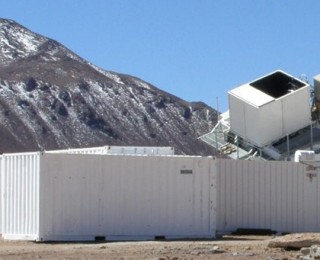
by Kirit Karkare | Aug 14, 2012 | Daily Paper Summaries
The QUIET telescope has been observing the CMB, looking for the gravitational wave background. Will it find the “smoking gun” for the theory of inflation?
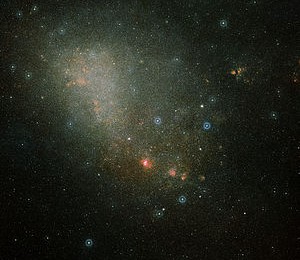
by Kirit Karkare | Jul 17, 2012 | Daily Paper Summaries
What can a nearby dwarf galaxy tell us about the the chemical evolution of the universe?
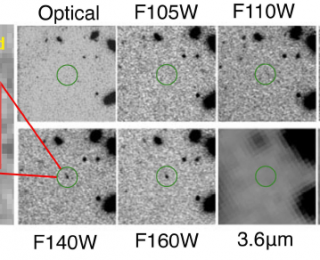
by Chris Faesi | Apr 14, 2012 | Daily Paper Summaries
Gravitational lensing has enabled the detection of a galaxy that may be the most distant object ever observed.
by Courtney Dressing | Mar 15, 2012 | Daily Paper Summaries
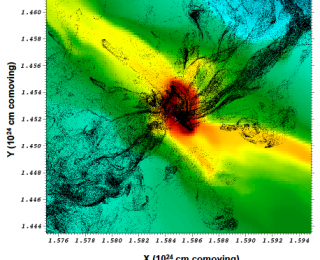
What if the first stars were only 1-50 times as massive as the Sun? Would they still be able to enrich the intergalactic medium and trigger the birth of the next generation of stars?
by Courtney Dressing | Feb 2, 2012 | Daily Paper Summaries
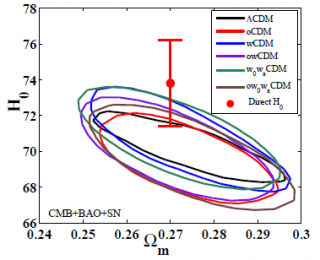
In this series of papers, the authors apply new analysis techniques to data from several galaxy redshift surveys to uncover acoustic waves from the early universe and refine measurements of cosmological parameters.
