by Shannon Hall | Feb 10, 2013 | Daily Paper Summaries
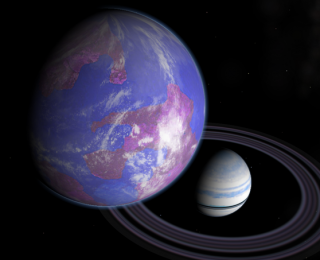
Some exoplanets seem to have walked directly out of the best science fiction movies. Taking these planets into example, the question of habitability seems like a joke. But what if we stopped looking at these extreme worlds and turned our eyes to their moons instead? Surely their moons are less extreme. And given that our own Jupiter hosts 67 moons, surely they’re more abundant. Can such extreme planets host habitable moons? The 36-page paper written by Heller and Barnes attempts to address this question.
by Adele Plunkett | Oct 12, 2012 | Daily Paper Summaries
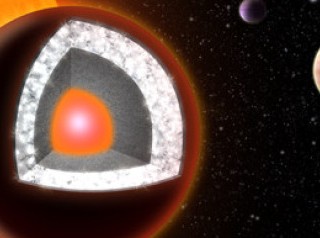
A team of astronomers and geologists have teamed up to study the composition of a rocky super-Earth which likely contains a layer of carbon in the form of diamond and graphite.
by Caroline Morley | Sep 21, 2012 | Daily Paper Summaries
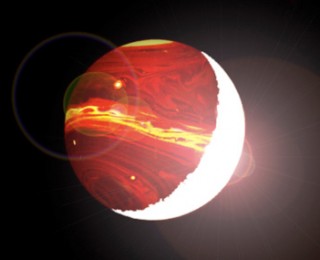
Astronomers have started trying to understand how to organize classes of exoplanets based on their physical characteristics. As it has turned out over the last ten years, exoplanets are considerably more complicated to classify than stars. The evolution of star is based (almost) exclusively on how massive it is at birth. Instead, this paper classifies hot exoplanets by their level of irradiation from their host star and their chemical composition.
by Caroline Morley | Dec 7, 2011 | Daily Paper Summaries
Venus transits the Sun, from the frame of the Earth, about twice every century, separated by eight years. The last one happened in 2004, and another is happening in June 2012. Observing the transmission spectrum during the 2012 transit—and comparing it to measured transmission spectra of the Earth, taken during lunar eclipses—will tell us how hard it will be to distinguish two planets that look identical in mass and radius, but have extremely different atmospheric properties.
by Susanna Kohler | Jun 17, 2011 | Daily Paper Summaries
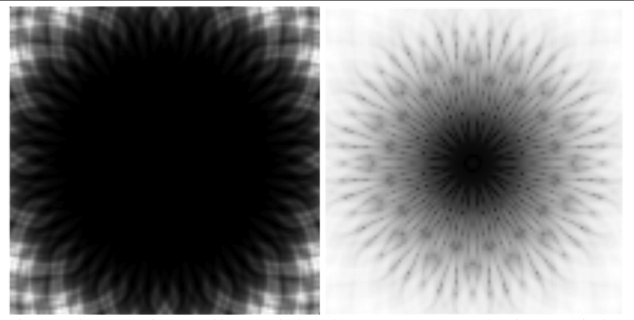
Direct imaging of exoplanets is a tricky business, but with a well-designed starshade blocking the light of the exoplanet’s parent star, it could be much easier! But how do you choose the right design?
