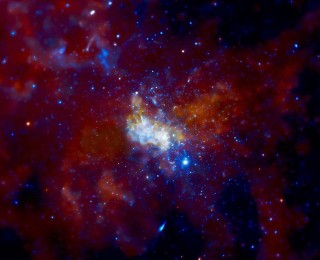
The Infamous Galactic Center Source G2: Gas Cloud or Star?
In this paper, the authors use near-IR imaging and spectroscopy to determine if G2, a galactic center source about to approach our galaxy’s supermassive black hole, is a gas cloud or a star.

In this paper, the authors use near-IR imaging and spectroscopy to determine if G2, a galactic center source about to approach our galaxy’s supermassive black hole, is a gas cloud or a star.
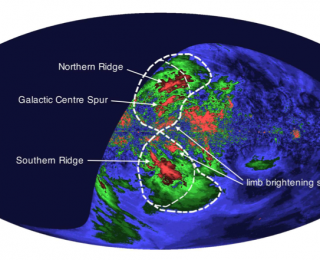
Carretti and collaborators have found new evidence that the gigantic bubbles of emission emanating from the center of our Milky Way are the result of winds from supernova explosions, not jets from our supermassive black hole.
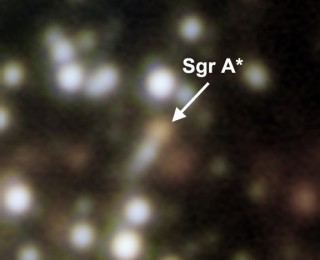
Witzel et. al examine the statistical properties of the photometric variability of our Galaxy’s central black hole.
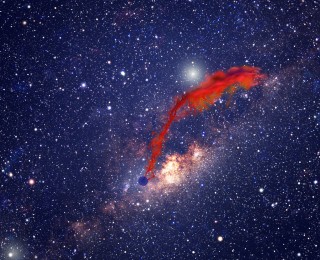
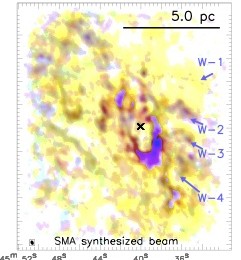
Recent studies have revealed a surprising amount of activity happening in the heart of our own Milky Way. In this paper, Liu et al. explore the kinematics of the gas outside the most central regions of our galaxy, and reveal that the Galactic center is being fed even more material from the main structure of the Milky Way.
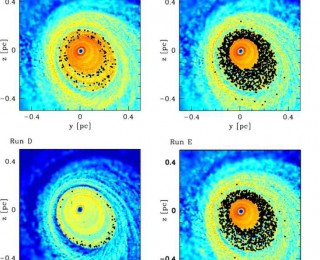
The Center of our Galaxy is one of the most extreme dynamical environments we can observe in detail because individual stars can actually be resolved using adaptive optics. Over time, monitoring individual stellar orbits has firmly established the presence of a supermassive black hole of about 4 x 10⁶ M☉ (check out this video too). Further examination of these fast-moving stars’ properties (via infrared spectroscopy) revealed a surprising detail — many of these stars are young!