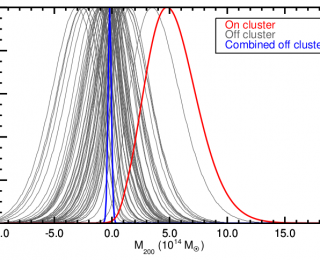
Weighing galaxy clusters with the CMB
Measuring CMB distortions caused by gravitational lensing is a unique way of estimating galaxy cluster masses.

Measuring CMB distortions caused by gravitational lensing is a unique way of estimating galaxy cluster masses.
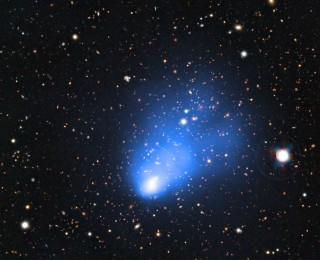
The El Gordo (in Spanish, “the fat one”), one of the most massive galaxy clusters observed, is an active merger of two large subclusters. Unraveling its dynamics provides insights into $latex \Lambda$CDM.
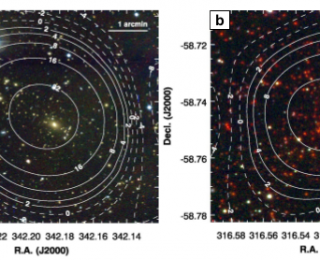
The Sunyaev-Zeldovich effect is a unique way of searching for galaxy clusters that complements multi-wavelength imaging efforts.
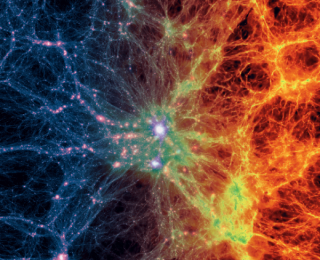
High resolution computational simulations are a valuable means by which Astronomers test our understanding of the Universe, and make predictions. The world of computational astrophysics broke new ground recently with the highest resolution cosmological simulation to date, Illustris, making for some spectacular science and some spectacular images.
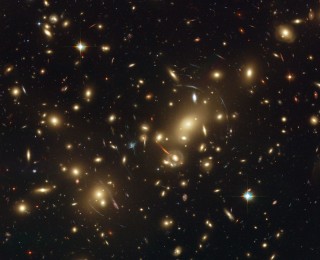
New results from stacked weak lensing measurements of over a hundred thousand galaxies show that, on large scales, light from stars appears to trace the dark matter distribution of the Universe remarkably well.
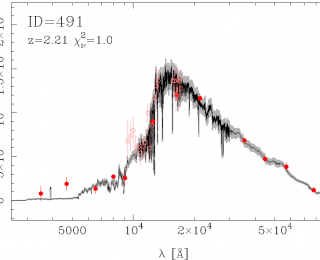
A galaxy cluster in the act of forming reveals some interesting details about the lives of galaxies.