by Nick Hand | Jun 10, 2012 | Daily Paper Summaries
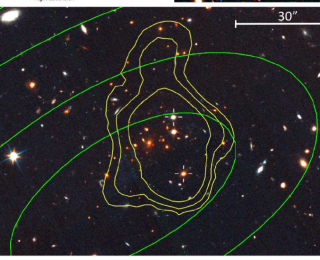
The authors discover a strong lensing arc behind an unusually massive galaxy cluster at high redshift. The existence of such a lensing system at high redshift is found to be inconsistent with the standard cosmological model.
by Allison Strom | May 7, 2012 | Daily Paper Summaries
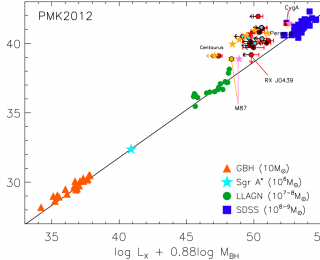
A team of astronomers at the University of Cambridge have uncovered evidence for ultramassive black holes in the giant elliptical galaxies that sit at the center of galaxy clusters. These whoppers could be up to ten times more massive than ordinary supermassive black holes, like the ones we usually find in centers of galaxies.
by Shannon Hall | Apr 29, 2012 | Daily Paper Summaries
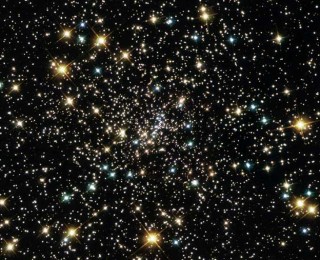
Blue stragglers are stars within a globular cluster that lie along an extension of the main-sequence, above the turnoff point. As such they appear to be much younger than the rest of their stellar population. Current research suggests that they form by coalescence of mass-transfer between two companions in a binary system and the merger of two stars induced by stellar collision. By observing the population distributions of blue stragglers in globular clusters we can learn about the mechanisms through which they formed and the evolutionary dynamics of the cluster itself.
by Justin Vasel | Apr 12, 2012 | Daily Paper Summaries
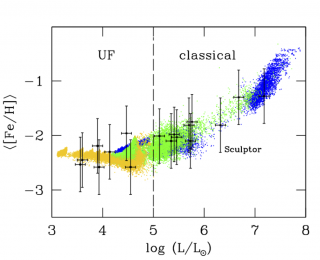
Living metal-poor stars represent the fossil records of the early cosmic star formation.
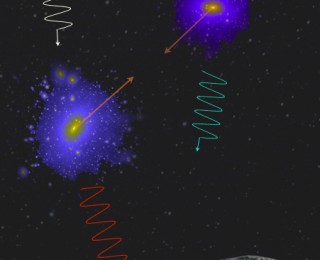
by Maria Drout | Apr 2, 2012 | Daily Paper Summaries
Astronomers present the first-ever detection of the motion of distant galaxy clusters via an effect first theorized 40 years ago.
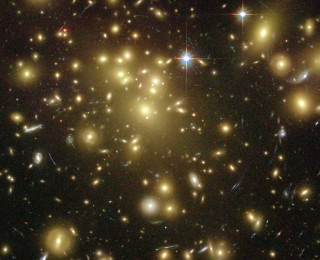
by Ryan Foltz | Mar 27, 2012 | Daily Paper Summaries
How do we locate galaxy clusters in the sky? We’ll examine the red sequence method in particular.
