by Nick Hand | Mar 17, 2012 | Daily Paper Summaries
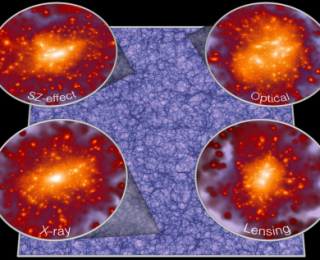
The authors of this analysis use the largest, high-resolution cosmological N-body simulation to date, the Millennium-XXL, to investigate sources of scatter in cluster scaling relations. They find that a wide range of biases can affect the most commonly used scaling relations.
by Ryan Foltz | Feb 21, 2012 | Daily Paper Summaries
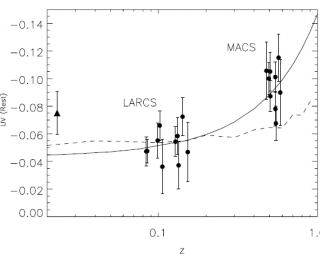
Title: The Evolution of the Red Sequence Slope in Massive Galaxy Clusters Authors: J. P. Stott, K. A. Pimbblet, A. C. Edge, G. P. Smith, J. L. Wardlow First Author’s Institution: Astrophysics Research Institute, Liverpool John Moores UniversityIn this post, we’ll examine a recent paper on the ongoing and controversial investigation into the evolution of the galactic color-magnitude relation. The color-magnitude relation is a phenomenon specific to galaxies in clusters, and I’ve written a post on the subject before. Studying the time evolution of this relationship is a powerful means with which to probe galaxy evolution, which means it can provide us with a picture of how structure formed in our universe.The Color-Magnitude RelationWe’ve known about the color-magnitude relation in some capacity since the 1950s. De Vaucouleurs noticed the effect in 1961 during his study of morphology in the Virgo cluster, and before him Stebbins and Whitford had found suggestive results in a handful of their galaxies. However, it wasn’t until Bower’s work in 1992 that the relation was conclusively demonstrated.So what is it? To put it simply, the color-magnitude relation just means that an elliptical or lenticular galaxy of a certain redness in a cluster will have a certain absolute magnitude, or brightness. A bluer galaxy is fainter. There are several things to note about the phenomenon:For one, the relation isn’t so exact that the galaxy must have the indicated magnitude, but Bower demonstrated that the relationship was in fact very good, with intrinsic scatter on the order of a few hundredths of magnitude for his sample. In fact, since we can determine a galaxy’s absolute magnitude to such precision, we can...
by Courtney Dressing | Feb 2, 2012 | Daily Paper Summaries
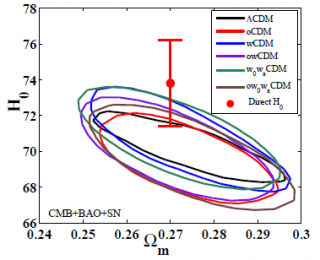
In this series of papers, the authors apply new analysis techniques to data from several galaxy redshift surveys to uncover acoustic waves from the early universe and refine measurements of cosmological parameters.
by Dan Gifford | Jan 24, 2012 | Daily Paper Summaries
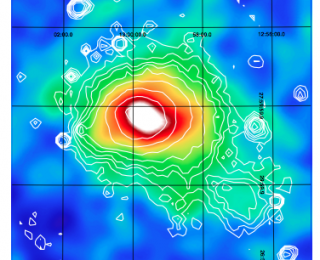
Estimating galaxy cluster masses is difficult, but it might be getting more precise thanks to the Sunyaev-Zeldovich effect.
by Elisabeth Newton | Jan 9, 2012 | Current Events
Simulations tell us of a web-like Universe but it’s hard to explore this topic observationally because we can’t see dark matter. But the Canada-France-Hawaii Telescope (CFHT) Lensing Survey has made the first large scale map of dark matter. On the first day of AAS #219, the CFHTLenS survey shared their results with us.a
by Adele Plunkett | Jan 6, 2012 | Daily Paper Summaries
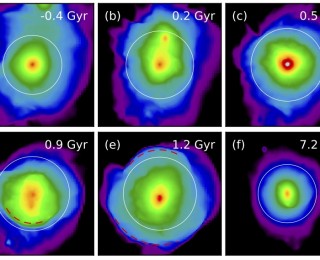
Galaxy clusters trace the matter density of the universe, and by counting clusters as a function of mass and redshift, cosmologists can learn about the expansion rate of the Universe
