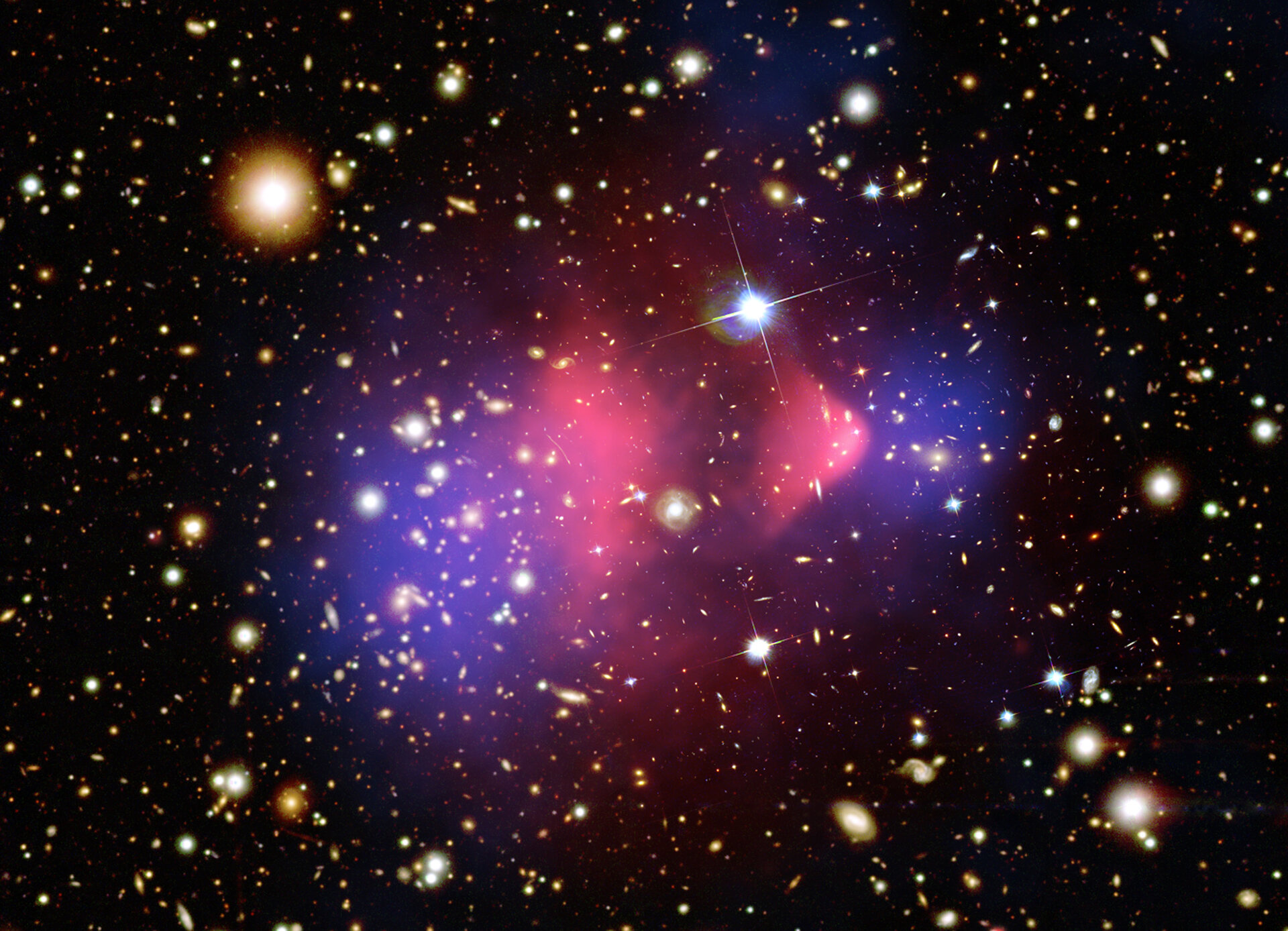
Less than meets the eye: measuring the bias in galaxy cluster observations
Today’s authors come up with a new way to account for foreground and background galaxies in galaxy cluster measurements.

Today’s authors come up with a new way to account for foreground and background galaxies in galaxy cluster measurements.

In today’s paper, the authors look for the more than 50% of matter in the universe that’s ‘missing’ from our count by searching for bridges between clusters of galaxies.

Bundle up – we’re taking a look at some cool simulations of cluster cold fronts.

Gravitational lensing is a natural result and unique feature of Einstein’s theory of general relativity. It is also an important instrument in the cosmologist’s toolkit. Today’s paper highlights one way astronomers are using gravitational lensing to study dark matter.

Could galaxy clusters be the new plastic lawn decor trend for fall?

Dark matter is very hard to study because, well, it’s dark. Today’s authors explore how the light we can see in galaxy clusters might not trace dark matter as well as we thought.