by Shannon Hall | Oct 4, 2013 | Daily Paper Summaries
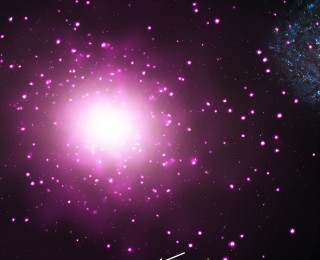
The densest galaxy in the local Universe may have been found. M60-UCD1 is most likely a tidally-stripped remnant of a more massive progenitor galaxy. Strader et al. predicts that the progenitor of M60-UCD1 was ~ 50-200 times more massive, suggesting that it was once an elliptical galaxy that has been stripped of most of its mass.
by Josh Fuchs | Jul 11, 2013 | Daily Paper Summaries
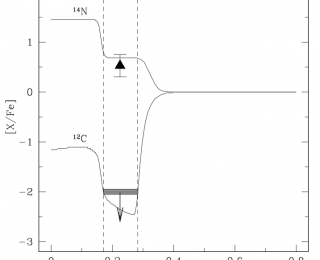
What kind of star is orbiting around a millisecond pulsar and where did it come from?
by Anna Rosen | Oct 9, 2012 | Daily Paper Summaries
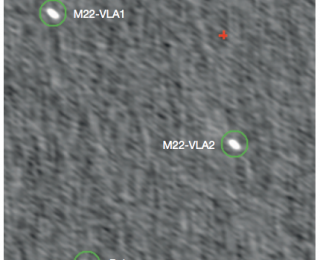
In this article, the authors report their serendipitous discovery of two stellar mass-black holes in the globular cluster M22, however theoretical work predicts that there should only be one stellar-mass black hole!
by Elizabeth Lovegrove | Jul 31, 2012 | Daily Paper Summaries
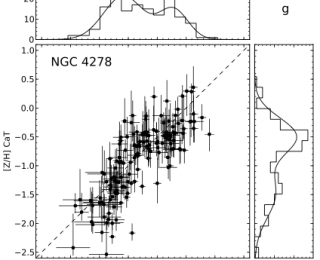
In this paper, the SLUGGS team explores an alternate way to determine the metallicity of a globular cluster based on the calcium triplet rather than color. Previous studies have shown what appear to be two peaks in the metallicity of the population of globular clusters surrounding early-type galaxies – a bimodal distribution – but some astronomers have pointed out that the way we measure metallicity in globular clusters can make a unimodal distribution in metallicity appear as a bimodal one. The SLUGGS team recalibrates the calcium triplet relation and surveys 903 clusters around 11 galaxies, and finds a similar bimodal distribution, implying that most massive galaxies undergo at least two star formation episodes.
by Anna Rosen | Jul 18, 2012 | Daily Paper Summaries
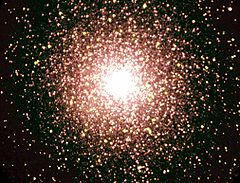
Globular clusters are some of the most massive and densest star clusters observed. What are the progenitors of old globular clusters that we see orbiting the Milky Way and other galaxies? What evolutionary and dynamical effects have these clusters experienced? What determines the physical properties of old globular clusters? Why are there two “distinct” classes of globular clusters and what properties determine these physical states? These are the questions the authors aim to answer.
by Kim Phifer | Jul 2, 2012 | Daily Paper Summaries
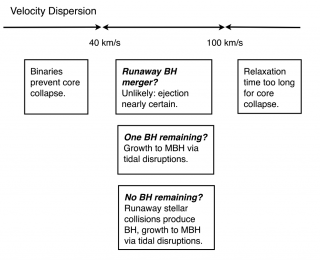
Miller & Davies investigate whether central black holes should exist in low mass stellar systems such as globular clusters.
