by Eckhart Spalding | Mar 4, 2017 | Daily Paper Summaries
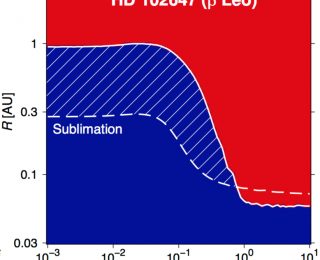
Today we try to get a sense of what near-in and hot dust disks are like around other stars. Aside from being interesting in its own right, the nature of ‘exozodis’ will offer more clarity for planning exoplanet direct-imaging missions.
by Guest | Oct 27, 2015 | Daily Paper Summaries
More than 100 massive stars orbit the supermassive black hole at the center of our galaxy incredibly closely.
by Meredith Rawls | Sep 29, 2015 | Daily Paper Summaries
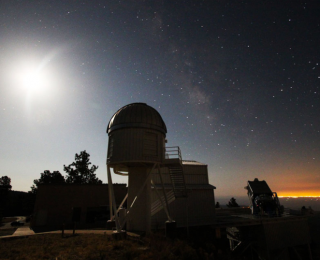
The three-year APOGEE survey was designed to target red giant stars in the Milky Way using near-infrared light, and today’s paper marks the final data release: half a million spectra of 146,000 stars. This treasure trove of data will be put to good use for years to come.
by David Wilson | Sep 28, 2015 | Daily Paper Summaries
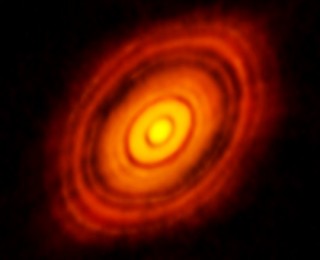
Nearly a year ago, the ALMA collaboration released this stunning image of the young star HL Tau. The sub-millimeter wavelengths of light that ALMA detects revealed a vast disc of gas and dust, several times larger than Neptune’s orbit. Intriguingly, the disc was divided up into a series of well-defined, concentric rings.
The cause of the rings seemed clear: There must be planets around HL Tau, their gravity sculpting the gas and sweeping out the dark gaps in the disc.
by David Wilson | May 12, 2015 | Daily Paper Summaries
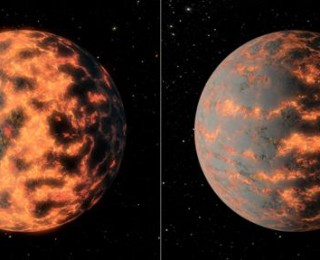
Of the more than 1500 exoplanets discovered over the past two decades, perhaps the most intriguing and unexpected have been the ultra-short period planets, worlds so close to their parent star that they complete an entire orbit in less than a day. Most are small, less than twice the radius of the Earth, and are so hot that their rocky crusts are being melted away. The debris could be used to investigate the composition of these mysterious worlds, but most of them are too small for our current instruments to observe in detail.
by Jesse Feddersen | Apr 6, 2015 | Daily Paper Summaries
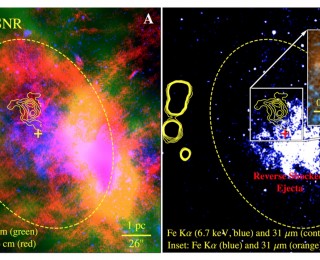
Observations of dust near the remains of a supernova in the center of our galaxy could have implications for dust production in the earliest galaxies.
