by Meredith Rawls | Jun 4, 2014 | Daily Paper Summaries
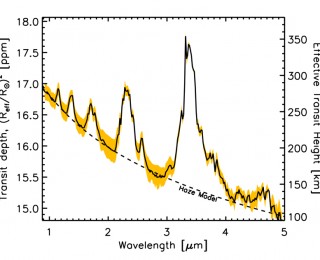
This paper uses Cassini’s infrared eyes to watch the Sun appear to pass behind Titan and light up its atmosphere. From these observations, the authors model different components of the thick atmosphere, and gain new insights about how exoplanets with similar hazy atmospheres might look.
by Korey Haynes | Jan 29, 2014 | Daily Paper Summaries
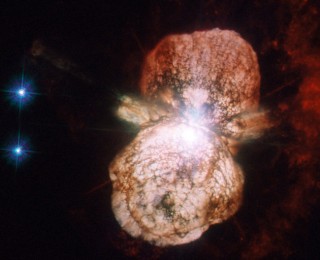
The massive star Eta Carinae has been observed in the infrared for over forty years. Between 1976 and 1998, astronomers saw a linear increase in the star’s brightness. But Eta Carinae has been steadily heating up ever since a close approach with its companion star in 1998, and astronomers want to know why.
by Anna Rosen | Apr 25, 2013 | Daily Paper Summaries
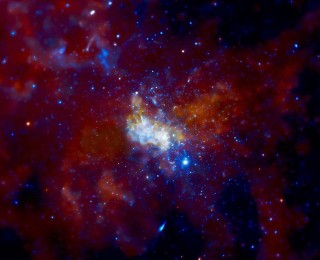
In this paper, the authors use near-IR imaging and spectroscopy to determine if G2, a galactic center source about to approach our galaxy’s supermassive black hole, is a gas cloud or a star.
by Kirit Karkare | May 21, 2012 | Daily Paper Summaries
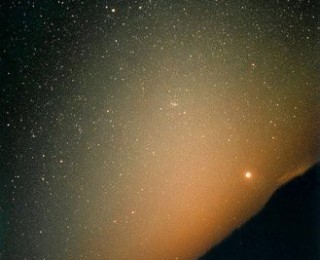
The zodiacal light may look beautiful, but it can get in the way of important observations. This paper suggests improvements to models of the dust cloud using observations from the Spitzer Space Telescope.
by Courtney Dressing | May 10, 2012 | Daily Paper Summaries
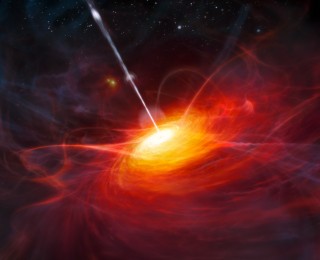
How does AGN activity influence star formation in active galaxies? Dai et al. combine multi-wavelength observations of 32 quasars to bring us closer to the answer.
by Adele Plunkett | Mar 2, 2012 | Daily Paper Summaries
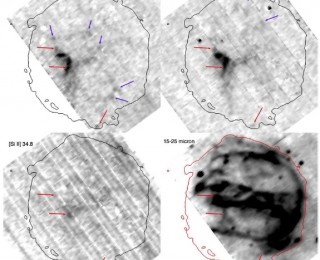
Paper title: Spitzer Imaging and Spectral Mapping of the Oxygen-rich Supernova Remnant G292.0+1.8 Authors: P. Ghavamian, K. Long, W. Blair, S. Park, R. Fesen, B. Gaensler, J. Hughes, J. Rho, P. F. Winkler First Author’s Affiliation: Towson University, MarylandA star ends its life in a violent supernova (SN) explosion according to one of two (general) mechanisms — (1) core-collapse, forming a neutron star or black hole and an extremely energetic shock wave; or (2) thermonuclear explosion of a white dwarf, leaving no central remnant and releasing a very characteristic amount of energy used to infer the distance to these standard candles. Core-collapse SNe can be further classified according to their progenitor stars as type II, Ib or Ic, while thermonuclear supernovae are known as type Ia. More discussion on types of SNe can be found here, or in this Science in the News piece by another astrobiter.One way to better understand how SNe progress is by studying the leftovers, or remnants, of these events (if you like supernova remnants, check out this astrobite too). For example, G292.0+1.8 is a collection of cosmic remains from an unrecorded supernova event that probably occurred about 3000 years ago, and it is unique for its oxygen-dominated optical spectra — hence, its classification as an oxygen-rich supernova remnant (SNR). Moreover, G292 is the remnant of a core-collapse SN, with filaments of gas and dust emitting light as shocks from the SNR propagate outward into the circumstellar medium. The goal of today’s paper is to study emission from G292 at different wavelengths in order to investigate the energy and the morphology of core-collapse SNe.Observations of...
