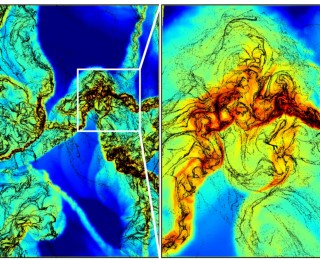
by Jesse Feddersen | Oct 14, 2015 | Daily Paper Summaries
Molecular clouds, where new stars are born, are made of two components: gas and dust. The gas is mostly hydrogen, and the dust is made of elements crucial for forming planets and people, like silicon and carbon. Today’s paper shows that these two components behave very differently in a simulated molecular cloud. This could have exciting consequences for the growth of dust and the formation of stars and planets.
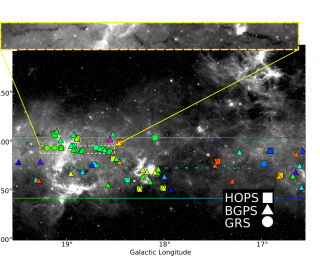
by Caroline Huang | Jul 3, 2015 | Daily Paper Summaries
How many spiral arms does the Milky Way have? You might be surprised to learn that astronomers are still not completely sure.
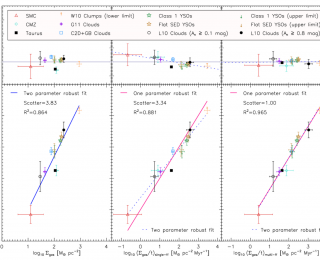
by Jesse Feddersen | Jun 1, 2015 | Daily Paper Summaries
Molecular clouds are turbulent. Today’s paper explores how this fact affects the relationship between star formation rate and density from local clouds to distant galaxies.
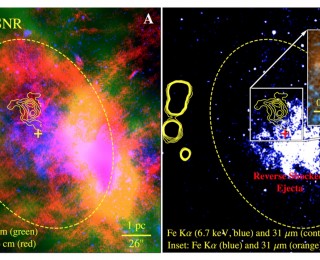
by Jesse Feddersen | Apr 6, 2015 | Daily Paper Summaries
Observations of dust near the remains of a supernova in the center of our galaxy could have implications for dust production in the earliest galaxies.

by Michael Küffmeier | Jan 13, 2015 | Daily Paper Summaries
Magnetic fields are a crucial part of star formation. Read on whether and how the magnetic field strength dissipates during the early collapsing phase.
by Michael Küffmeier | Dec 9, 2014 | Daily Paper Summaries
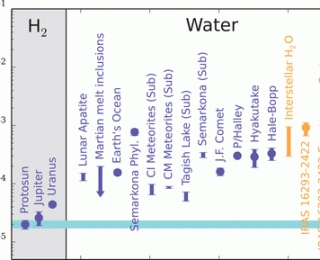
Water is essential for life, but where does it come from? Read on and learn that a significant amount is inherited from the interstellar medium.
