by Michael Hammer | Jun 16, 2017 | Daily Paper Summaries
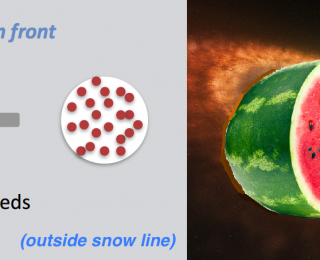
Beyond the snow line, water in a protoplanetary disk condenses into ice. In simple models, this is supposed to make it possible for planetesimals and in turn, giant planets to form. Can that storyline hold up in the more detailed model from today’s paper?
by Joseph Schmitt | Apr 20, 2017 | Daily Paper Summaries
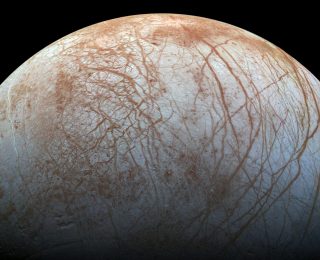
Strong evidence of cryovolcanism on Jupiter’s Moon Europa spells good news for its habitability.
by Michael Hammer | Apr 5, 2016 | Daily Paper Summaries
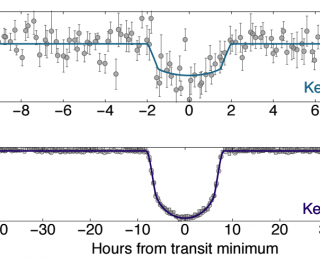
Look up in the sky. It’s a bird! No, it’s a background eclipsing binary! No, it’s Kepler-167e: the first transiting exoplanet that’s just like Jupiter!!!
by Gudmundur Stefansson | Oct 1, 2015 | Daily Paper Summaries
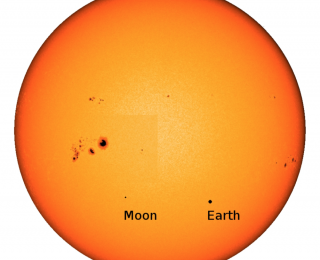
How do you observe an Earth transit, from Earth? You use some of the Solar System’s largest mirrors. The authors did. They found an anomaly.
by David Wilson | Jun 9, 2015 | Daily Paper Summaries
Among the many ideas proposed to explain the formation of our Solar system, one of the leading theories is the “Grand Tack”. This scenario suggests that, early in their formation, Jupiter and Saturn undertook a sweeping voyage, migrating from the outer Solar System to within the orbit of Mars. The two huge planets then entered an orbital resonance with each other, before their cosmic dance took them back out to their current positions. The model neatly explains, amongst other things, the current locations of Mars, the Asteroid Belt and the outer planets—which are hard to recreate in models assuming a more static Solar System.
by Becky Smethurst | Mar 26, 2015 | Daily Paper Summaries
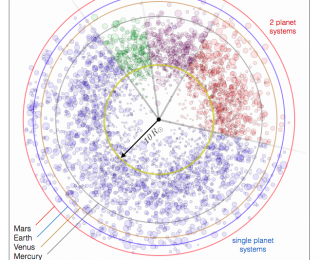
Our Solar System is just plain odd compared to other star systems across our galaxy. Once again the finger of blame points towards the gas giant Jupiter as the simulations in this paper show.
