by Jaime Green | Nov 5, 2014 | Daily Paper Summaries
Those of us who love astrobiology get really worked up about the lack of Earth-sized exoplanets found at Earth-like distances from their stars. All we want, we who hope for lots of extraterrestrial life, is a bunch of Earth-like planets doing Earth-like things so we can feel better about the odds for lots of Earth-like life in the universe.
by Yvette Cendes | Nov 1, 2014 | Daily Paper Summaries
Title: Limits on low frequency radio emission from southern exoplanetsAuthors: Tara Murphy, et al.First Author Institution: Sydney Institute for Astronomy, The University of Sydney, AustraliaStatus: Accepted for publication in MNRASAstrobites is no stranger to exotic exoplanet discoveries– the Kepler mission alone has increased our knowledge of these worlds by leaps and bounds, and many exciting discoveries have been done by optical telescopes as well through a variety of methods. In today’s paper, however, the authors present results on yet another method of extrasolar planet detection: the possibility of discovering planets in radio frequencies.How does this work? Well we know that planets with high magnetic fields can give of gigantic radio flares in the right circumstances- in our own solar system, Jupiter gives off flares that can be brighter than the sun in radio frequencies thanks to its powerful magnetosphere (which produces bright aurorae like Earth’s magnetosphere- see Figure 1). This is thanks to something called cyclotron maser emission, where electrons from plasma material interact with the magnetic field in a way that beams them like a laser in radio frequencies. In the case of Jupiter, these bursts are visible from Earth when Io– the nearest Galilean moon to Jupiter, which is constantly spewing out material from its volcanoes- is at a particular point in its orbit and this beam of radio radiation is pointed towards us.Of course, if such a thing is a well-documented phenomenon in our own solar system with Jupiter, shouldn’t it also occur around other planets? Astronomers think so, and such flares have been observed from brown dwarfs, but the question is whether these exoplanet radio flares would be strong enough to be detectable from Earth. The answer is “perhaps,” under circumstances such as if the exoplanet is...
by Elizabeth Lovegrove | Sep 22, 2012 | Current Events, Guides
Fact: Jupiter is the best planet. What’s not to like? Big, beautifully stripey, four exciting moons, hurricane three times the size of the Earth, lots of fascinating hydrodynamics…I could go on. But Jupiter isn’t just awesome on its own. It was also the site of the first observed extraterrestrial impact event, and is routinely struck by asteroids and comets. Last week on Monday the 10th another piece of cosmic debris impacted the planet, producing a brief fireball spotted by amateur astronomers and providing an excellent opportunity to reflect on the history of impacts in Jupiter and the solar system at large.Jupiter has 67 known satellites, but only 8 are considered regular, i.e. they have stable, prograde, roughly circular, roughly planar orbits. The rest of the satellites are irregular and are likely captures. Jupiter’s mass means that it scoops up nearly everything that passes near it. The area of gravitational influence around a body orbiting another, much larger body is called the Hill sphere. Within the Hill sphere a satellite can be considered to orbit the smaller object (the planet) rather than the central one (the Sun). The Earth has a Hill sphere radius of about 1.5 million km, or 1% of the distance between it and the Sun. Jupiter, on the other hand, has a Hill sphere radius of about 53 million km – 0.355 AU, or nearly 7% of the distance between it and the Sun. This radius is well away from the bulk of the main asteroid belt, but close enough to pick up strays – and anything foolish enough to come close to the giant planet.In 1993 astronomers Carolyn and Eugene Shoemaker...
by Elisabeth Newton | Aug 30, 2012 | Classics, Daily Paper Summaries
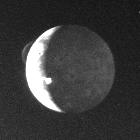
It’s March 2, 1979. Two years ago, the Voyager spacecraft were launched on trajectories that will allow them to carry out their primary missions: the study of the outer Solar System, in particular Jupiter and Saturn. It’s just three days before Voyager 1’s closest approach to Jupiter. The paper that was published on March 2nd, 1979 in Science is a prediction for what the Voyager spacecraft might see on Io based on the orbital motions of these three satellites.
by Elisabeth Newton | Mar 28, 2012 | Daily Paper Summaries
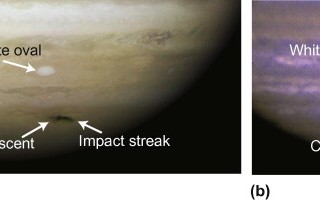
The impact of comet Shoemaker-Levy 9 was a remarkable event: in 1994, a comet, torn into pieces during a close approach with Jupiter two years prior, crashed into Jupiter. It was the first collision between two solar system bodies to ever be observed, and the effects on Jupiter’s atmosphere (see the figure below) were visible for months. At the time, Harrington et al. (2004) predicted that it would be hundreds of years before such an event occurred again. But two and a half years ago, another object collided with Jupiter. No one witnessed the collision, but amateur astronomer A. Wesley noticed a dark streak with properties closely matching those seen after the impact of SL-9. Because of these similarities, it is believed that this feature was the result of an impact.
by Elisabeth Newton | Jul 5, 2011 | Daily Paper Summaries
In this paper, techniques from helioseismology – using waves to learn about the interior of the Sun – are applied to yet another object: Jupiter. Because Jupiter is largely a fluid, like the Sun, astronomers have expected it to show global seismic behavior since the mid-1970s; the signal was even theorized to be about the same magnitude as solar oscillations. However, attempts to detect Jupiter’s global oscillations in the 80s and 90s were largely unsuccessful.
