by Caroline Morley | Jan 17, 2013 | Daily Paper Summaries
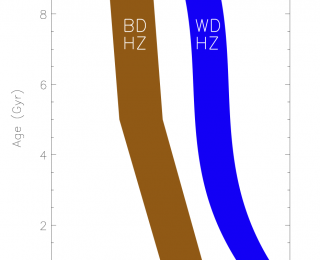
The holy grail for exoplanet science would be to find an inhabited planet. Not just habitable, but actually inhabited. But where are we most likely to find those planets? Only around Sun-like stars, or could life thrive around other types of stars? Could evolved stars like white dwarfs or neutron stars harbor life? Could brown dwarfs, the so-called failed stars, have inhabited planets?
by Nathan Sanders | Nov 28, 2011 | Daily Paper Summaries
The latest episode in the saga of GJ1214b appeared on the arXiv Wednesday.

by Lauren Weiss | Sep 21, 2011 | Guides, Personal Experiences
When we dream of other worlds, there is one thing that drives our fantasies of life above all else: water. Most organisms on Earth rely on this molecule for survival. Although we might imagine life forms that do not require water, planets with water are the most obvious places to search for life—or at least for life as we know it.Thus, the discovery of the first potential “water world” in 2009 was a turning point in exoplanet science. At the time, I was a senior at Harvard University working with David Charbonneau, whose team and their robotic telescopes discovered the super-Earth GJ 1214b when it transited its star. In a Nature publication, Dave describes the discovery.The planet is just the right density to be made entirely of water. However, the discovery of GJ 1214b only suggests its watery nature; the planet could have a dense, rocky core and a large but light atmosphere of hydrogen and helium instead.To distinguish between these possibilities, several groups have performed transmission spectroscopy. This technique measures the starlight that passes through the planet’s atmosphere while the planet transits its star. By measuring the light transmitted at different wavelengths, it is possible to construct a spectrum of the planet’s atmosphere. Absorption and emission lines in the spectrum can reveal chemicals in the atmosphere.Counter-intuitively, the scientists studying GJ 1214b are not looking for spectral lines due to water. Models show that adding water vapor to the atmosphere of GJ 1214b would flatten the spectrum, smearing out all features. However, a high layer of clouds could also produce such a spectrum, so a flat spectrum does not...
by Caroline Morley | May 10, 2011 | Daily Paper Summaries
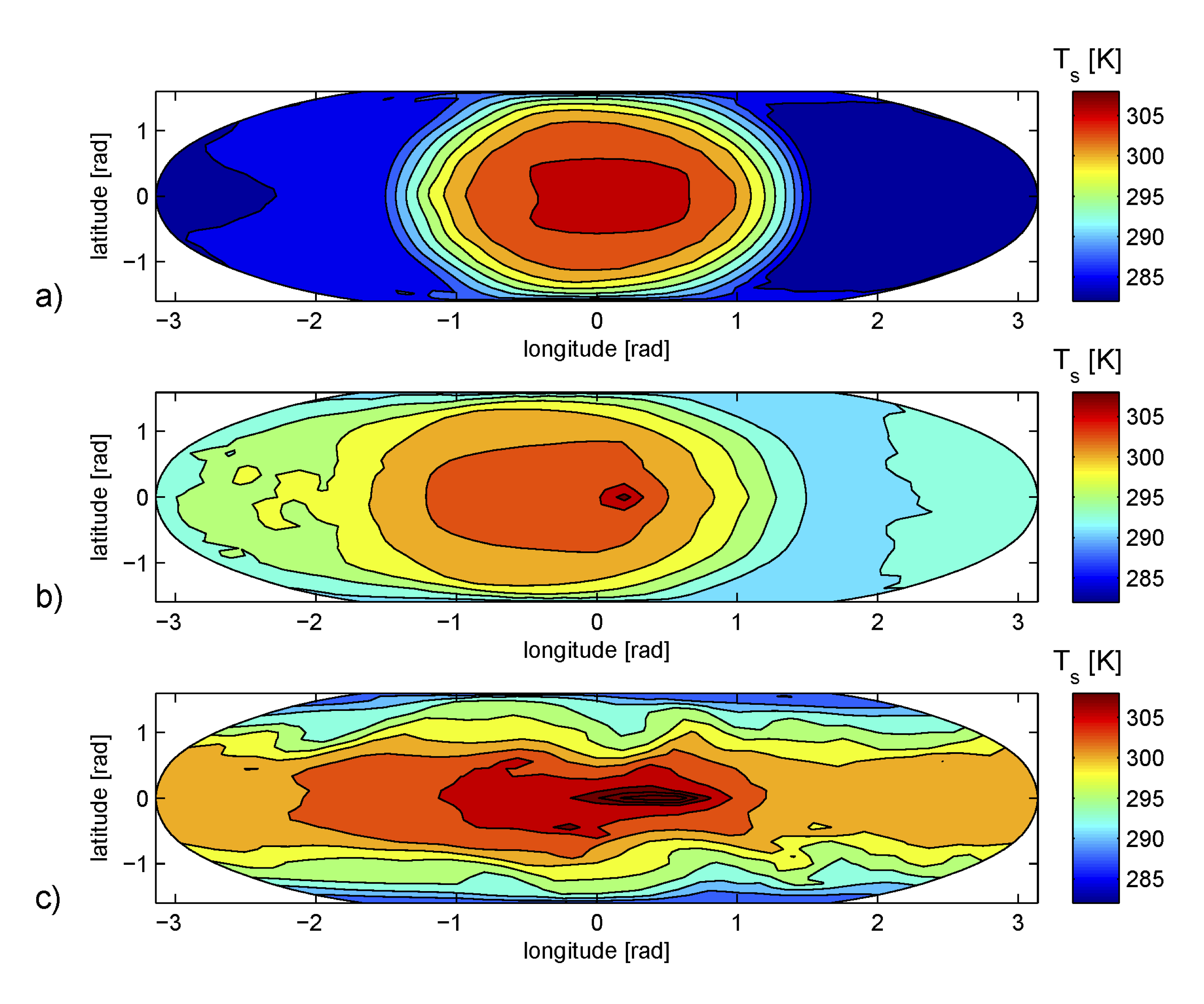
One of the important goals of exoplanet science is to discover habitable planets that have the necessary conditions for life to form and thrive. Such planets will exist within the ‘habitable zone’ of a star. In this paper, the authors present Global Circulation Models which suggest that Gliese 581d could be in the habitable zone if it has a thick carbon dioxide-rich atmosphere.
by Courtney Dressing | Feb 21, 2011 | Daily Paper Summaries
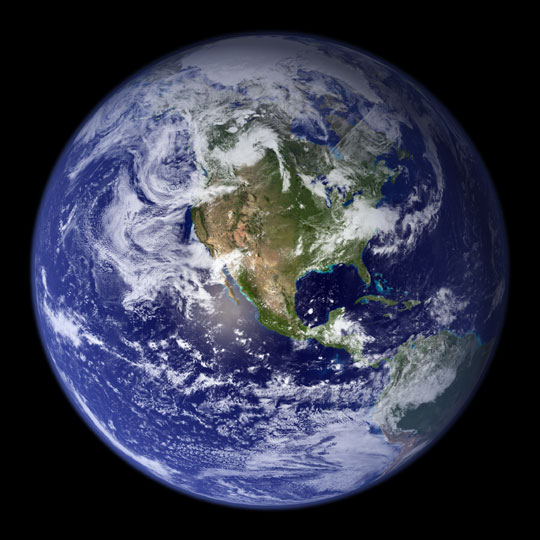
Assuming that we have acquired the spectrum of a distant terrestrial planet, what would it look like? Would we able to resolve surface features? More excitingly, would we be able to detect biomarkers in the atmospheres of alien Earths?
