by Caroline Morley | May 31, 2012 | Daily Paper Summaries
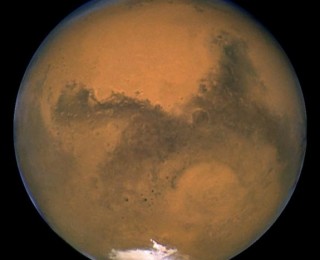
Mars is observed to have sedimentary rocks, which provide proof that liquid water once existed on the Martian surface. However, the surface of Mars would have been too cold to have permanent rivers and lakes; the authors of this paper suggest seasonal snowmelt could create enough liquid water to form these rocks.
by Courtney Dressing | Mar 29, 2012 | Daily Paper Summaries
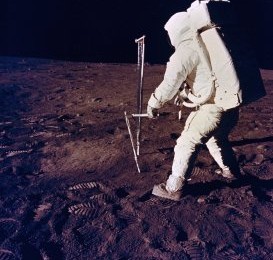
Are robotic missions really more efficient than human space exploration? Ian Crawford explains why planetary astronomers should support human space exploration.

by Susanna Kohler | Jul 7, 2011 | Career Navigation, Daily Paper Summaries
Ever wonder how the game of football would change on Mars? These undergrads at University of Leicester did! Here’s a summary of their thoughts, and a discussion of what this can teach us about being scientists.
by Sukrit Ranjan | Mar 26, 2011 | Personal Experiences
This past February, I had the opportunity to travel to Mars – or just about as close as you can get on Earth. I was privileged to be a part of the all-student Crew 99 of the Mars Desert Research Station (MDRS), which did work on astrobiology, mission planning, and astronomy engineering.MDRS is an analog Mars facility in the Utah desert, built, owned, and operated by the Mars Society (purpose: “to explore and settle the planet Mars”). The objective of the facility is to simulate living and working on Mars, so we can encounter, overcome, and learn to manage as many problems as we can before actual landings and exploration commence. During the January-April field season, crews of 6 head to MDRS for 2-week rotations. In addition to the general Mars exploration objectives associated with MDRS, each crew also brings with it a slate of scientific research objectives, often related to astrobiology or exploration engineering.Our crew was built around our astrobiology experiment: project LAMBDA. LAMBDA was an extension of our summer 2010 group project as part of the NASA Ames Academy for Space Exploration. LAMBDA was inspired by a couple of papers (Abrevaya et al 2010, Miller and Oremland 2008) which explored a new way to detect life: microbial fuel cells (MFCs). The idea goes as follows: all known life metabolizes, and in particular metabolizes via redox biochemistry. Microbial fuel cells use these redox reactions to generate electricity. Redox reactions in the anode chamber generate free electrons. Electronegativity differences between the anode and cathode cause electrons to be taken up by the electrodes and flow from the anode to...
by Katherine Rosenfeld | Mar 18, 2011 | Daily Paper Summaries
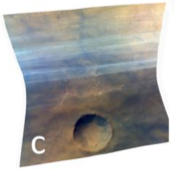
Meteorology of other planets in our solar system provides critical laboratories for testing our climate models, studying new weather mechanisms, and developing climate theories for other worlds. This particular paper discusses a method for identifying carbon dioxide clouds on Mars using infrared spectroscopy.
