by Korey Haynes | Jan 29, 2014 | Daily Paper Summaries
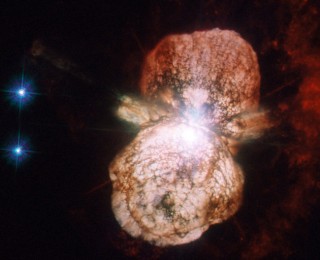
The massive star Eta Carinae has been observed in the infrared for over forty years. Between 1976 and 1998, astronomers saw a linear increase in the star’s brightness. But Eta Carinae has been steadily heating up ever since a close approach with its companion star in 1998, and astronomers want to know why.
by Shannon Hall | Jul 18, 2013 | Daily Paper Summaries
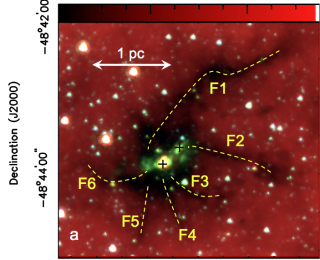
The formation of massive stars is still an intense topic of debate. Observations are difficult because massive star forming regions are heavily obscured by dust – invisible in the optical and near infrared. The trick is to look at much longer wavelengths. Today’s paper does just that, using the Atacama Large Millimeter Array (ALMA) in Chile to observe the birth of a massive star in submillimeter wavelengths. At 500 times the mass of the Sun and 1 million times brighter, it is the largest forming protostar ever seen in our galaxy.
by Anna Rosen | Dec 5, 2012 | Daily Paper Summaries
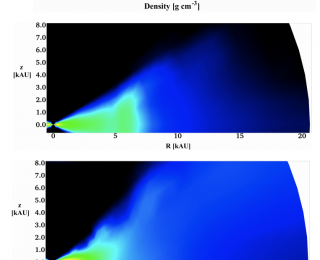
In this article, the authors study the effects of an optically thick disk around a forming massive protostar and examine how treating the gas opacity in the innermost dust-free region correctly affects the overall formation of massive stars.
by Maria Drout | Sep 17, 2012 | Daily Paper Summaries
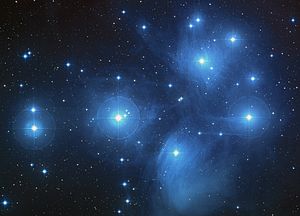
Several months ago NASA put out a request for information to astronomers asking what the main scientific goals of the next generation of Ultra-Violet space missions should be. These authors submitted a white paper arguing the case for massive star science.
by Anna Rosen | Sep 12, 2012 | Daily Paper Summaries
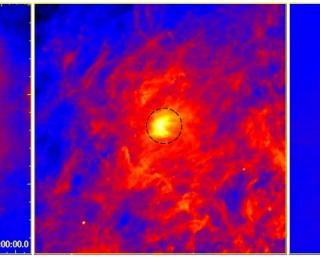
These authors describe a novel method to determine the mass-loss rates of massive runaway stars.
by Courtney Dressing | Jun 22, 2012 | Daily Paper Summaries
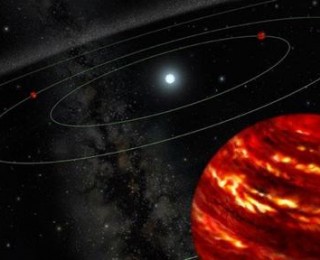
What fraction of massive stars host gas giants? Vigan et al. observe a sample of A and F stars to find out.
