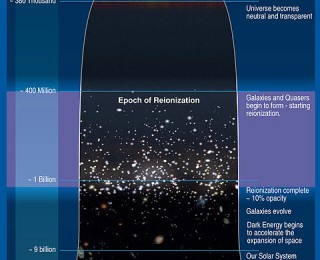
Runaway Stars in High-Redshift Galaxies: A Solution to the Reionization Problem?
Can the ionizing radiation from massive run-away stars be a leading source of reionization in the early universe?

Can the ionizing radiation from massive run-away stars be a leading source of reionization in the early universe?
Could higher than expected mass-loss rates for evolved massive stars lead to progenitors for peculiar Supernovae?
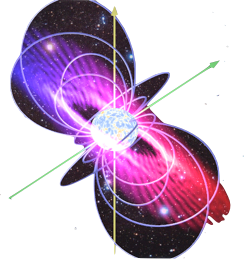
The Magnetism in Massive Stars (MiMeS) project is a statistical survey to answer the big questions related to magnetism in hot, massive stars. So far they have observed 166 stars, 14 of which host strong, ordered magnetic fields.
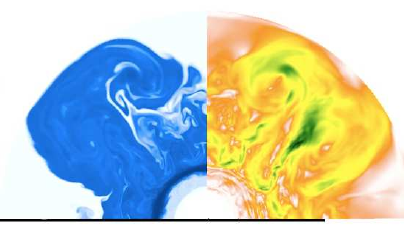
Supernovae are vitally important in the chemical and dynamical evolution of galaxies, but we don’t yet fully understand the physics that produce these explosions. This new work simulates the turbulent instabilities in a star at the brink of core-collapse.
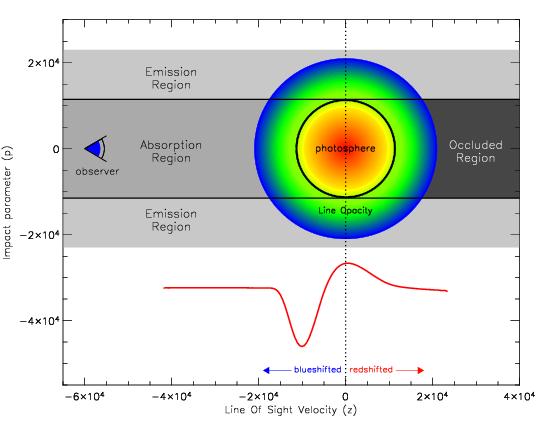
Not all stars are as well-behaved as our Sun. Some reprobate massive stars (greater than several solar masses) can flare, outflow, and even eject a significant amount of their material into the interstellar medium.