by Meredith Rawls | Jan 22, 2015 | Daily Paper Summaries
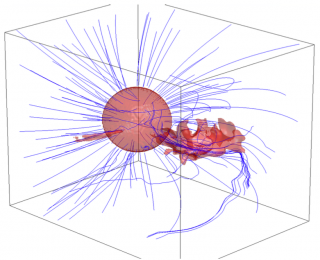
In today’s paper, Čechura and Hadrava examine what happens to the runaway gas from the surface of massive stars—the stellar wind. In particular, they look at systems with massive stars so close to a companion neutron star or black hole that the stellar wind is jarred into a new orbit and heated to the point of emitting X-rays.
by Korey Haynes | Nov 7, 2014 | Daily Paper Summaries
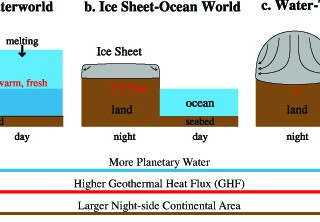
Yang et al. use climate models to investigate whether rocky exoplanets around M-stars can retain their oceans in the face of tidal locking.
by Erika Nesvold | Apr 11, 2014 | Daily Paper Summaries
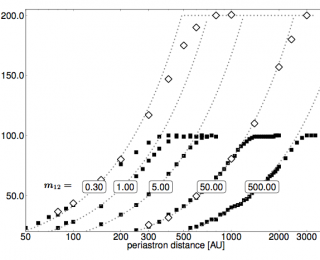
A close encounter with another star can disrupt the protoplanetary disk of a young star, leaving a smaller disk behind. Can we learn anything about the encounter from the size of the remaining disk? Read on to find out!
by Erika Nesvold | Feb 14, 2014 | Daily Paper Summaries
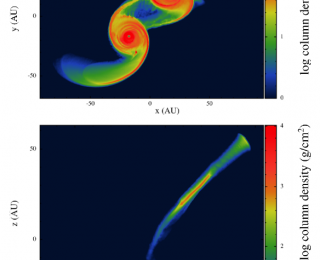
Close encounters with a passing star can excite a planet into an eccentric or inclined orbit. But a circumstellar disk can damp a planet’s eccentricity and inclination. Who wins? Find out when the authors of this paper model a stellar flyby with two circumstellar disks!
by Astrobites | Jun 15, 2013 | Undergraduate Research
The undergrad research posts continue! This month’s post discusses meteor-modeling.
by Erika Nesvold | Jan 4, 2013 | Daily Paper Summaries
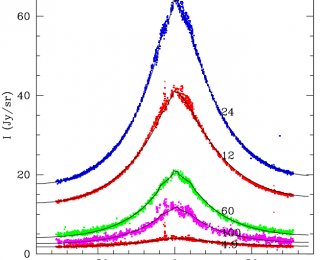
The Solar System’s interplanetary dust (called zodiacal dust) can be a source of noise in infrared and optical observations, but it also holds information about the recent history of the Solar System. This new and improved model of the zodiacal dust reveals the relative contributions to the dust by asteroids, comets, and interstellar dust.
