by Justin Vasel | Nov 7, 2013 | Daily Paper Summaries
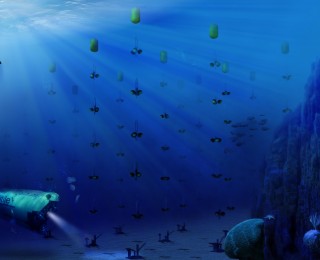
A neutrino detector sits on the floor of the Mediterranean Sea whose goal it is to identify neutrinos from high-energy astrophysical sources.

by Astrobites | May 19, 2013 | Undergraduate Research
The undergraduate research series has been revived! This month’s post features research on neutrinos from failed supernovae and compact-object mergers, as well as research on magnetic fields in the intracluster medium.
by Elisa Chisari | Mar 2, 2013 | Daily Paper Summaries
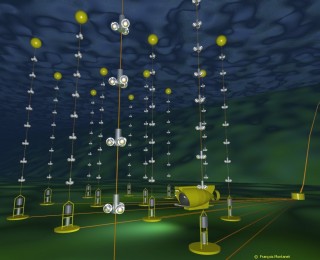
The quest for identifying the dark matter particle is well underway. Today, we discuss the work of the ANTARES collaboration, which is using a neutrino telescope to search for signals of dark matter annihilation in the Sun.
by Elizabeth Lovegrove | Oct 23, 2012 | Daily Paper Summaries
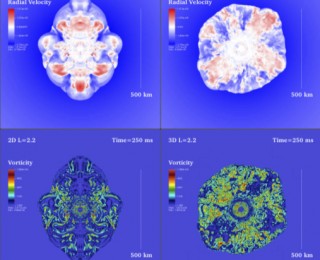
The neutrino reheating mechanism works out in theory to trigger core-collapse supernovae, but we’ve had a lot of trouble getting it to work in 3-dimensional simulations. Because of the prohibitive computational expense, really accurate neutrino physics have thus far only been implemented in 2D. This paper seeks to investigate whether there are systematic differences in fluid behavior between 2D and 3D models in order to figure out whether a 2D model can really stand in for a 3D one.
by Justin Vasel | May 24, 2012 | Daily Paper Summaries
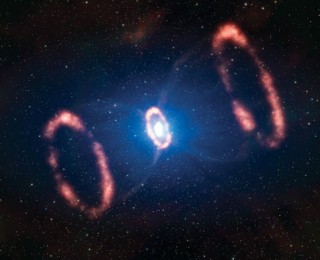
The SuperNova Early Warning System (SNEWS) uses neutrino detectors across the globe to predict when a supernova is about to become visible, providing astronomers the unprecedented opportunity to study the next supernova as it happens.
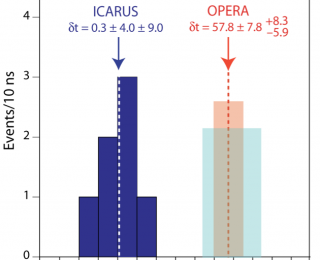
by Elizabeth Lovegrove | Mar 19, 2012 | Current Events, Quick Notes
In our last update on the situation regarding OPERA’s superluminal neutrino measurement, I said that the true test of the result would be whether it stood up to independent verification. Since the controversial result was announced last November, neutrino detector experiments have scrambled to help settle the neutrino time-of-flight with their own findings. Now the first of those independent results has come in, and the outlook looks good for fans of special relativity: the ICARUS experiment, a time projection chamber located in the Gran Sasso tunnel, has made its own measurements of the same CERN beam used by OPERA, and has found no evidence of superluminal velocities.ICARUS is another experiment located in the Gran Sasso tunnel, an Italian facility buried beneath a mountain in the Apennines. Because it’s in the same place as OPERA, it can also make measurements of the beam fired from CERN. Unlike OPERA, which measures neutrinos by watching for flashes in photoscintillation material, ICARUS is a time-projection chamber. Time-projection chambers are a modern upgrade of bubble chambers, using a large cryogenic target volume (in this case, liquid argon) gridded with electronic detectors that pick up the signatures of collisions. Using this method, ICARUS looked for neutrino interactions from the widely-spaced beam that CERN switched to in late 2011. The long spacing between brief pulses – 3 ns bursts separated by 524 ns – makes it much easier for the experiments on the other end to be sure of the timing, because it’s clear which origin pulse each neutrino belongs to.According to relativistic theory, neutrinos should be moving extremely quickly because they have such small masses....
