Shifting the Pillars – Constraining Lithium Production in Big Bang Nucleosynthesis
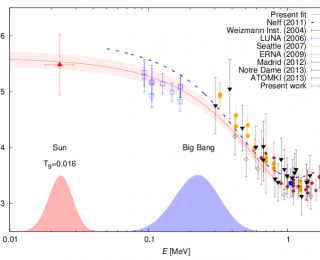
Solar neutrinos constrain the origin of the elements in the Big Bang.

Solar neutrinos constrain the origin of the elements in the Big Bang.
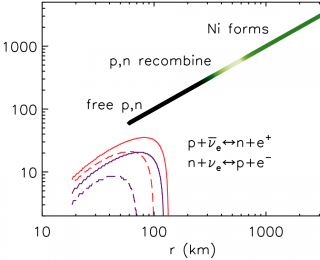
There aren’t many places in the universe that you can find a bunch of free neutrons not already trapped inside a nucleus—except in neutron stars. Luckily, neutron stars in violent mergers with other neutron stars, or with black holes, tend to disperse a little bit of their matter into the interstellar medium. Tidal forces eject some matter as the two objects swing around each other in their final orbits. Then, if an accretion disk forms, winds blown off the surface of the disk disperse even more matter. Surman and her colleagues look at the nucleosynthesis that occurs in this latter process, and find something surprising.
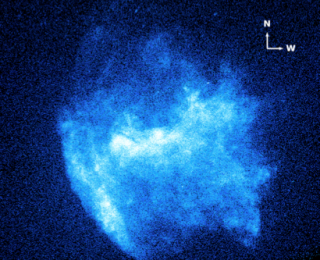
The authors discuss the possibility that the strangely-shaped supernova remnant W49B was created by a core-collapse supernova that formed strong bipolar jets instead of a spherical shockwave.
You’ve probably heard the old quote from Cosmos that “we are all made of stardust.” But that’s not the whole story. How that dust gets made is an intricate tale that spans a wide range of stellar processes and masses. This is the field of nucleosynthesis, the making of the chemical elements, and it is what allows us to make the simple statement: toothpaste comes from neutrinos.
Stars are essentially element factories: most of the elements which we know (and dearly love, for life’s sake) were produced by some aspect of stellar evolution, either during their long, uneventful tenancy on the main sequence, shorter and swifter time as a red giant branch star, or their catastrophic death as supernovae.
A number of recent developments, such as particle accelerators and the detection and characterization of the Cosmic Microwave Background (CMB) have revolutionized our understanding of the synthesis of the elements. As one might expect, nucleosynthetic processes are relevant to a wide range of astrophysical phenomenon, and this chapter is equally broad in its scope to explain them all.