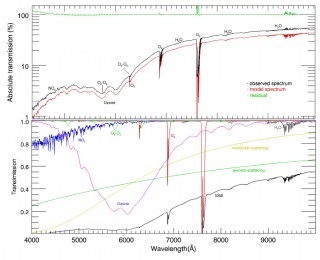
Earth as an exoplanet via the Moon
It sounds convoluted: today’s astrobite observed a lunar eclipse in order to learn about the Earth’s atmosphere, to understand more about how to observe exoplanets. How and why do they do this? Read on…

It sounds convoluted: today’s astrobite observed a lunar eclipse in order to learn about the Earth’s atmosphere, to understand more about how to observe exoplanets. How and why do they do this? Read on…
Orbiting our galaxy are many smaller dwarf galaxies. As they orbit, some of these galaxies produce vast streams of gas that stretch around our Milky Way galaxy. Much of this gas still has the potential for forming stars. This astrobite will summarize a recent discovery of one of these stars.
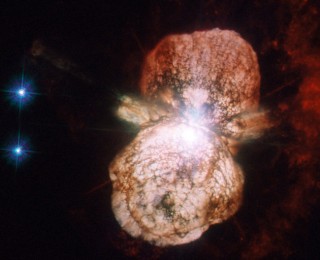
The massive star Eta Carinae has been observed in the infrared for over forty years. Between 1976 and 1998, astronomers saw a linear increase in the star’s brightness. But Eta Carinae has been steadily heating up ever since a close approach with its companion star in 1998, and astronomers want to know why.
The undergrad research posts continue! This month’s post discusses two types of clusters: clusters of galaxies, and open clusters of stars in our own galaxy.
The undergrad research posts continue! This month’s post discusses the orientation of galaxies in the Universe.
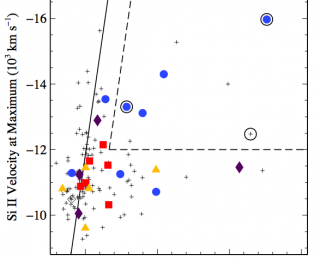
What if type Ia supernova are not all made the same way? For the first time, a study links type Ia supernova explosions to their parent systems, uncovering evidence for two different ways to produce these purportedly “standard” explosions.