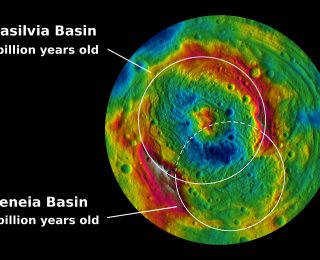
Basaltic asteroids might not all be from Vesta
Most basaltic asteroids are thought to originate from the dwarf planet Vesta. However, some of these asteroids are far from Vesta and exhibit different spectra, implying a second point of origin.

Most basaltic asteroids are thought to originate from the dwarf planet Vesta. However, some of these asteroids are far from Vesta and exhibit different spectra, implying a second point of origin.
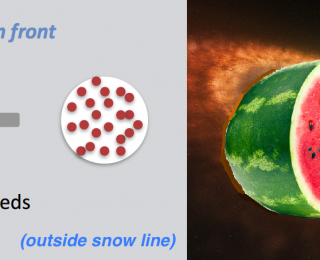
Beyond the snow line, water in a protoplanetary disk condenses into ice. In simple models, this is supposed to make it possible for planetesimals and in turn, giant planets to form. Can that storyline hold up in the more detailed model from today’s paper?
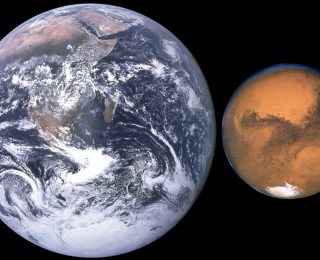
J’onn J’onzz needs astronomers’ help figuring out why his home planet of Mars is smaller (and hence, less habitable) than the Earth. He already asked the rest of the Justice League, but they could not solve the problem. Can Drążkowska et al. save the day?
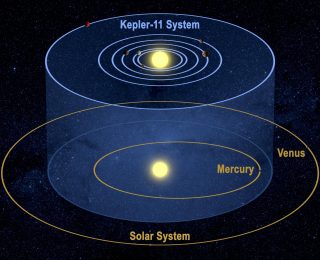
Roughly half of all planetary systems have planets much closer to their stars than Mercury is to our Sun. Can a system’s magnetic field during the stage of planet formation explain why half of all systems (including our own) do not have these planets when the other half do?
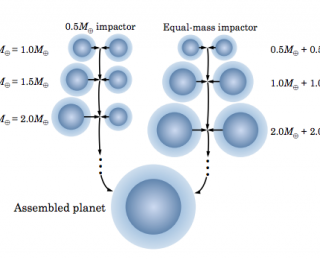
Super-Earths could form close-in to their stars… but what about their atmospheres?
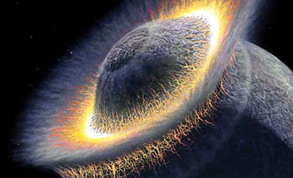
The Giant Impact Hypothesis is the most widely accepted theory for the creation of the Moon; the authors here investigate possible configurations of the early Solar System to produce the right conditions for impact between Earth and the doomed proto-planet Theia.