by Meredith Rawls | Jan 14, 2014 | Daily Paper Summaries
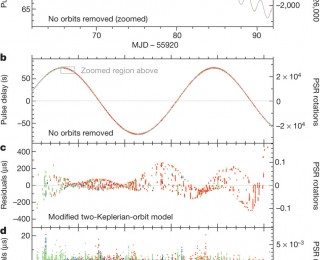
One of nature’s best clocks is a millisecond pulsar. These exotic stellar corpses are neutron stars: incredibly dense, rotating hundreds of times per second, and emitting powerful jets or beams of light. This creates a “pulsing” effect, much like a lighthouse.
by Astrobites | Dec 6, 2013 | Undergraduate Research
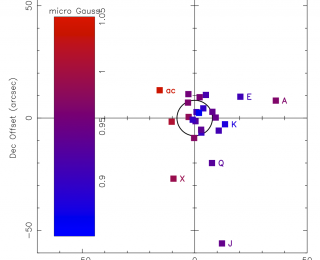
This month’s undergraduate research post features pulsars as a probe of our galaxy’s magnetic field, and the possibility of asymmetries in supernovae associated with gamma-ray bursts.
by Yvette Cendes | Nov 22, 2013 | Daily Paper Summaries
Title: Evidence of an Asteroid Encountering a Pulsar Authors: P. R. Brook, A. Karastergiou, S. Buchner, S. J. Roberts, M. J. Keith, S. Johnson, R. M. Shannon First Author’s Institution: University of Oxford Pulsars- neutron stars formed during supernovae explosions- are often considered the “precision clocks” of radio astronomy. This is because of two fundamental properties observed from their radio pulses: the average emitted radio beam- known as the pulse profile– remains very stable over decades, and the pulsar has extreme rotational stability thanks to its fast rotation. All pulsars have a rotational frequency, ν, which is gradually decreasing due to a loss of energy, and its change with time, the spin-down rate, tells radio astronomers about the stability of the pulsar. Hundreds of pulsars have been observed to have glitches where the pulsar’s rotational frequency is seen to increase rapidly, and there have even been anti-glitch observations where the pulsar abruptly slowed down, which are thought to be caused by the magnetic fields of the pulsar.But the interesting thing about astronomy is even in a field where things are as precise as pulsars, surprises will still crop up. And this is what happened during a 24-year observing campaign of PSR J0738-4042, when in September 2005 the spin-down rate abruptly changed and a new radio component was observed. In fact, no previously understood mechanism can explain these changes, and the observations led the paper’s authors to propose they witnessed an asteroid encountering the pulsar.The observations were relatively straightforward: PSR J0738-4042 is a bright radio pulsar and was the target of a monitoring campaign by the Hartebeesthoek Radio Astronomy Observatory (HartRAO) in South...
by Susanna Kohler | May 24, 2013 | Daily Paper Summaries
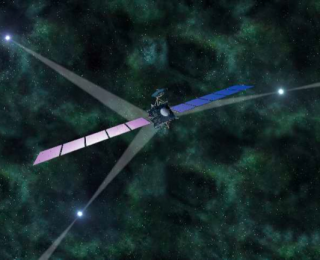
As we push spacecraft to the edges of our solar system and beyond, it gets harder and harder to navigate them from Earth. But what if spacecraft could steer themselves, using observations of pulsars? Read on to find out how!
by Josh Fuchs | May 16, 2013 | Daily Paper Summaries
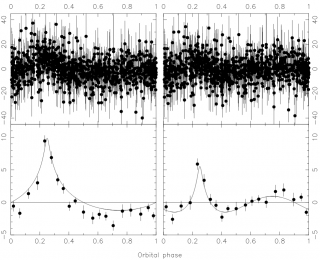
Shapiro time delays are one of the four tests of general relativity possible in the solar system. Astronomers can use these timing delays to measure properties of binary pulsar systems.
by Chris Faesi | Nov 23, 2012 | Daily Paper Summaries
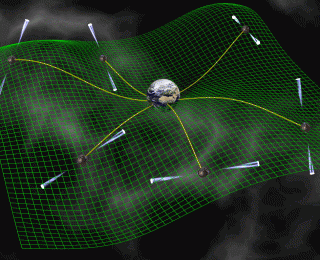
The race to be the first to detect gravitational waves is on – are pulsar timing arrays on the verge of a discovery? New predictions based on revised galaxy merger calculations suggest that it may be so.
