• RSS
  • Submit a Guest Post
  • Undergraduates: Submit your Research!
  • Suggest a Paper Topic!
astrobites
  • About
    • About Astrobites
    • Meet the Authors
    • Statement of Inclusivity
    • Copyright & Permissions
  • Latest Research
    • Daily Paper Summaries
    • Classics
    • Undergrad Research
    • Physical Review Coverage
  • Beyond astro-ph
    • Beyond astro-ph Library
    • Interviews
    • Career Navigation
    • Personal Experiences
    • Current Events
    • Teaching with Astrobites
  • Guides
    • EM Spectrum
    • Galaxies & AGNs
    • Spectroscopy and Spectral Lines
    • Adaptive Optics
    • Gravitational Waves
    • Transient Astronomy
    • Astrophysical Software
    • Graduate School
    • Writing a personal statement for grad apps
    • First Observing Run
    • …More Guides!
Select Page
Honey, it’s an Intermediate Mass Black Hole this time!

Honey, it’s an Intermediate Mass Black Hole this time!

by Bhawna Motwani | Mar 13, 2017 | Daily Paper Summaries

Here’s a long-sought finding for y’all! Read on to find out more.

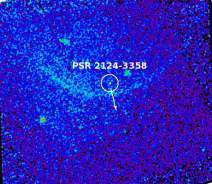
A Too-Hot Pulsar Speeding Through the Galaxy

A Too-Hot Pulsar Speeding Through the Galaxy

by Thankful Cromartie | Jan 10, 2017 | Daily Paper Summaries

What happens when a pulsar plows through our Galaxy at irresponsible speeds, exceeding the sound speed of the interstellar medium? The answer may (bow) shock you.
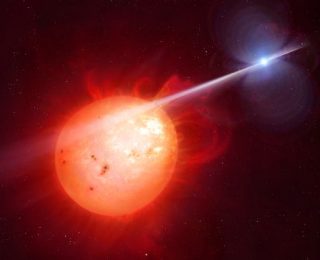
AR Sco — The First White Dwarf Pulsar

AR Sco — The First White Dwarf Pulsar

by Matthew Green | Dec 23, 2016 | Daily Paper Summaries

New polarisation data confirms that pulsations from a white dwarf system are powered by the same process that causes pulsars.
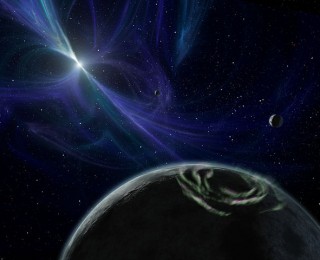
Why Are Pulsar Planets Rare?

Why Are Pulsar Planets Rare?

by Joseph Schmitt | Oct 5, 2016 | Daily Paper Summaries

Pulsar planets were the first planets outside the solar system ever discovered, but they now appear to be very rare. What makes a pulsar planet so uncommon?
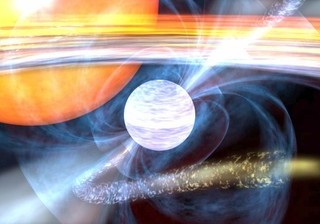
Irregular Clocks: The Influences of Generous Companions

Irregular Clocks: The Influences of Generous Companions

by Stacy Kim | May 7, 2015 | Daily Paper Summaries

Pulsars, or rapidly-spinning neutron stars, have been observed to suddenly change in spin. Typically, the pulsars we’ve seen do this are isolated—what happens if they have a stellar companion?
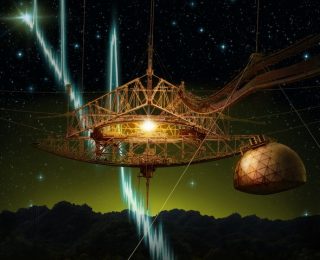
Arecibo Detects a Fast Radio Burst

Arecibo Detects a Fast Radio Burst

by Yvette Cendes | Apr 18, 2014 | Daily Paper Summaries

A mysterious Fast Radio Burst (FRB) from beyond the galaxy has been detected at Arecibo. This is the first FRB discovered outside of Parkes Observatory, giving greater credence to the astronomical nature of these signals.

« Older Entries
Next Entries »

Loading

Follow our socials

  • Bluesky
  • Facebook
  • Instagram
  • RSS Feed

More Posts About

AAS AGN astronomy astrophysics binary stars black holes cosmology dark matter dwarf galaxies exoplanets galaxies galaxy evolution gravitational waves habitability JWST Kepler Milky Way observations planetary science planet formation protoplanetary disks radio astronomy simulations solar system spectroscopy star formation stars stellar evolution supernovae theory

Posts by Category

  • Accessibility
  • Applications
  • Beyond
  • Book Reviews
  • Career Navigation
  • Classics
  • Climate Change
  • Course Assignments
  • Crossposts
  • Current Events
  • Daily Paper Summaries
  • Game Reviews
  • Guides
  • Historical Astronomy
  • Instrumentation
  • Interviews
  • Outreach
  • Personal Experiences
  • PRJ
  • Quick Notes
  • Satellites
  • Teaching
  • Undergraduate Research

More Astronomy

  • AAS
  • AAS Nova
  • astro-ph
  • AstroBetter
  • APOD

Read Astrobites in Other Languages

  • Astrobitos (Spanish)
  • Astropontos (Portuguese)
  • staryab (Farsi)

Listen to Astrobites

  • astro[sound]bites

Discover More Incredible Science

  • ScienceBites Network
  • RSS

© 2026 Astrobites | All Rights Reserved | Supported by AAS | Designed by Elegant Themes | Powered by WordPress