by Joseph O'Rourke | May 23, 2013 | Daily Paper Summaries
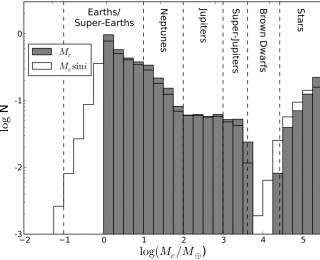
Our simple formula for predicting the probability that an exoplanet will transit might miss something important.
by Courtney Dressing | Nov 8, 2012 | Daily Paper Summaries
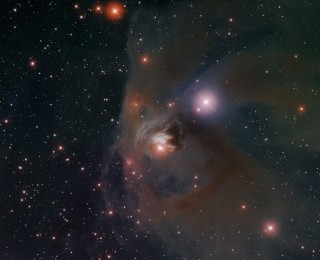
How long does planetary migration take? Crockett et al. look for the answer by searching for hot Jupiters around extremely young stars.
by Adele Plunkett | Oct 12, 2012 | Daily Paper Summaries
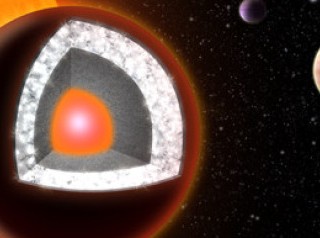
A team of astronomers and geologists have teamed up to study the composition of a rocky super-Earth which likely contains a layer of carbon in the form of diamond and graphite.
by Evan Schneider | Mar 20, 2012 | Daily Paper Summaries
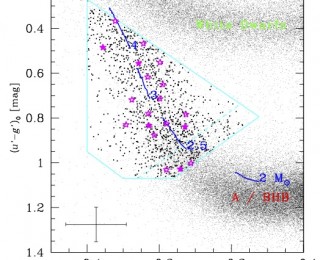
Five new hypervelocity stars have been discovered in the outer regions of the Milky Way. In this paper, the authors discuss what these stars are, how they got so far away, and what their distribution implies about the center of our galaxy.
by Elizabeth Lovegrove | Mar 5, 2012 | Guides
I like Cracked. You probably do too. But like that old adage that every newspaper story is true except for the ones for which you happen to have firsthand knowledge, I found their recent article on 6 Real Planets That Put Science Fiction To Shame to be . . . lacking. Not lacking in funny, or facts, but lacking in my favorite planets, and some of the weirdest specimens the universe has yet to offer up. So, without further ado, here are 6 more real planets (plus a bonus) that any sci-fi editor would have rejected as “too out there” just a few decades ago.
by Guest | Nov 26, 2011 | Guides
This post is written by Benjamin Nelson, a graduate student in the Astronomy Department at the University of Florida. He works with Dr. Eric Ford on the characterization and dynamical evolution of extrasolar planets. He is currently developing an N-body Markov chain Monte Carlo for RV observations of exoplanet systems. Why is this important to astronomy? Inevitably in your astronomical career, you’ll attend some talk where the speaker mentions “MCMC” and “Metropolis-Hastings”, or maybe something about “priors” and “likelihood functions.” The latter terms refer back to a Bayesian framework, while the former terms are the numerical tools, both of which are rarely covered in undergraduate astronomy/physics. Although Bayes’ theorem has been around for more than 200 years, computational advances within only the past couple decades have made it actually practical to solve problems involving Bayesian techniques. Learning statistical methods is like eating your vegetables: you probably won’t enjoy it, but it’ll be good for you in the long run. It is hardly motivating for an astronomy grad student to pick up an introductory book on Bayesian statistics without some practical application in mind, but a solid knowledge of Bayesian methods is a great way to find common ground in other, unfamiliar astronomical subfields, or even other disciplines of science. The purpose of this astrobite is to familiarize the reader with conventional Bayesian jargon (sugar coated with some astronomy) and lay out the ingredients to code a Markov chain Monte Carlo from scratch. Bayes’ Theorem: In short, Bayes’ theorem allows us to update our knowledge of a model system using new sets of observations. We use this to quantify the...
