Hide and Seek Planets
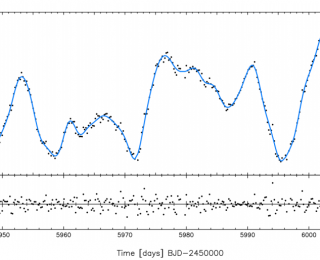
Is CoRoT-7d real, or is it stellar activity masquerading as a planet? Haywood et al. build a noise model to analyze CoRoT-7’s activity to find out.

Is CoRoT-7d real, or is it stellar activity masquerading as a planet? Haywood et al. build a noise model to analyze CoRoT-7’s activity to find out.
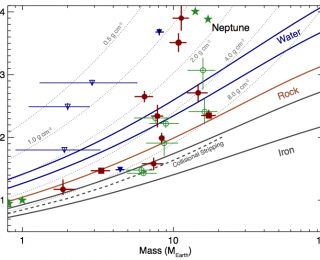
According to planet formation theory, gas giants are more massive than rocky, terrestrial planets. But Kepler-10c is the size of Neptune, and denser than the Earth! Read on to find out more about the discovery of a new class of planets.
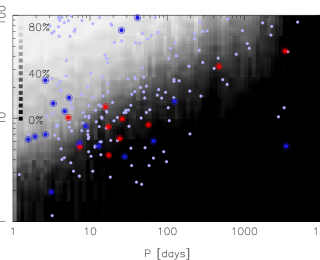
A recent result on the commonality of exoplanets has made headlines, but has it for the right reasons?
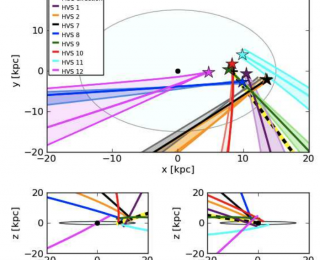
Palladino et al. find 13 new hypervelocity star candidates in the galaxy and find they probably do not originate from the center of the galaxy.
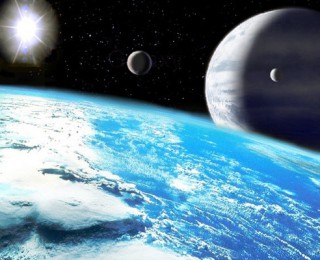
This paper reports that the M-dwarf star GJ667C is orbited by a system of six, maybe seven super-Earths, of which three are in the habitable zone. This is an extraordinarily closely packed system of planets, straight from science fiction!
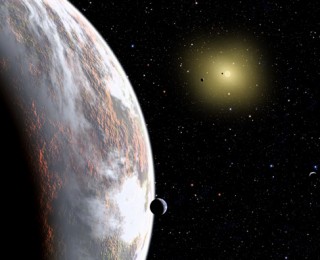
This paper describes the detection of transits for a planet previously identified via radial velocities (RVs). Measuring the properties of the planet with both the transit and RV method allows the authors to determine the density, which suggests it should have a lot of volatiles (e.g. H2O, CO2, etc). This discovery is particularly exciting because the planet orbits a bright, nearby star: ideal for follow-up observations to characterize its atmosphere!