by Andrew Emerick | Jan 27, 2015 | Daily Paper Summaries
Feedback processes, like supernova and AGN, are essential for accurately simulation galaxy formation and evolution. Today’s astrobite examines the role of radiation feedback in galaxy formation in new “radiation hydrodynamics” simulations of galaxies.
by Ryan Foltz | Oct 11, 2013 | Daily Paper Summaries
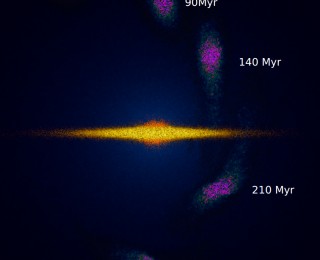
Using the upcoming Gaia telescope to measure ripples in the Milky Way will allow us to detect the impact of clumps of dark matter on our host galaxy.
by Elizabeth Lovegrove | Sep 23, 2013 | Daily Paper Summaries
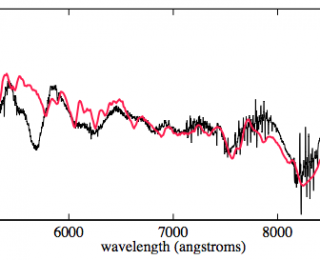
In this paper the authors present simulations of a model to explain rapidly-fading supernovae, a class of transients whose lightcurves decline quickly without substantial radioactive tails. They posits a standard core-collapse explosion of a standard Type Ib/Ic supernova progenitor, but one that produces very little radioactivity and instead exhibits a light curve governed by oxygen recombination.
by Elizabeth Lovegrove | Oct 23, 2012 | Daily Paper Summaries
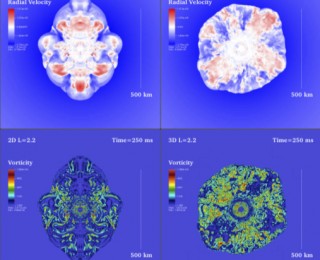
The neutrino reheating mechanism works out in theory to trigger core-collapse supernovae, but we’ve had a lot of trouble getting it to work in 3-dimensional simulations. Because of the prohibitive computational expense, really accurate neutrino physics have thus far only been implemented in 2D. This paper seeks to investigate whether there are systematic differences in fluid behavior between 2D and 3D models in order to figure out whether a 2D model can really stand in for a 3D one.
by Susanna Kohler | Sep 7, 2012 | Daily Paper Summaries
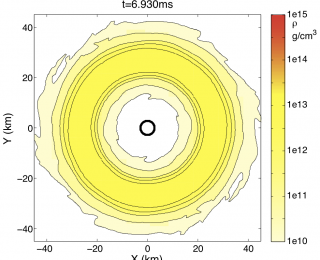
What happens when a neutron star collapses into a black hole? What kind of signal could we expect to see? These theorists have some ideas…
by Elizabeth Lovegrove | Aug 28, 2012 | Daily Paper Summaries
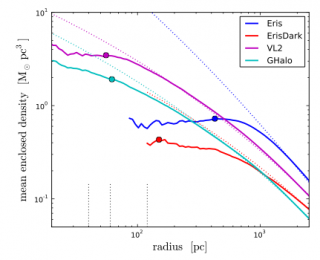
As Astrobites reported a couple of months ago, the Fermi-LAT gamma-ray telescope has reported an anomalous peak at 130 GeV, which could be the long-sought annihilation signature of dark matter. However, one of the strongest critiques of this potential discovery is that the signal is not coming from Sgr A*, the dynamical center of the Milky Way, but rather from about 200 parsecs away. Kuhlen et al. challenge the idea that the dark matter peak must be located at the dynamical center, and find that the combined dark matter-baryonic matter simulation Eris shows a well-defined, consistent offset between its dark matter peak and dynamical center.
