by Ashley Villar | Jun 30, 2015 | Daily Paper Summaries
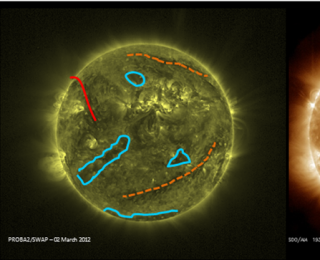
How to teach a computer to do all of your work for you!
by Suk Sien Tie | Jan 30, 2015 | Daily Paper Summaries
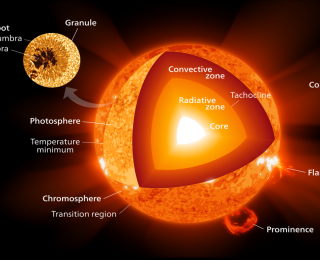
We thought we know our Sun well, since it’s one of the most heavily and closely studied astrophysical objects. Nevertheless, certain aspects of the Sun still linger out of our grasp.
by Erika Nesvold | Oct 23, 2014 | Current Events
North Americans will enjoy a partial solar eclipse this afternoon. Read more to find out the best ways to view the eclipse!
by Nathan Sanders | Oct 28, 2013 | Daily Paper Summaries
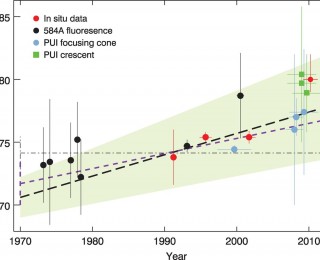
Douglas Adams’ fictional Ford Prefect famously warned us of eddies in the spacetime continuum. Has the IBEX spacecraft now found evidence that they really exist?
by Elizabeth Lovegrove | Jan 29, 2013 | Daily Paper Summaries
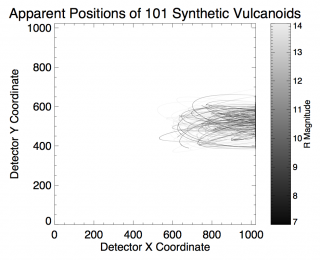
TITLE: A Search for Vulcanoids with the STEREO Heliospheric Imager AUTHORS: A. J. Steffl, N. J. Cunningham, A. B. Shinn, D. D. Durda, S. A. Stern FIRST AUTHOR’S INSTITUTION: Southwest Research Institute, BoulderThe recent evidence for an asteroid belt in the Vega system highlights how well we’re getting to know the solar systems around other stars. But there are some surprising gaps in our knowledge of our own. Inwards of the orbit of Mercury, there exists a dynamically stable region between about 0.21 AU and 0.07 AU where objects can orbit without being perturbed by Mercury or vaporized by the Sun. As far back as 1859 astronomers proposed that there might be at least one small planet lurking in this region, at the time a potential explanation for the odd precession of Mercury, and gave this hypothetical world the name “Vulcan”. Although Mercury’s orbital behavior was later explained by Einstein using general relativity, the idea of close-in planetesimals called “Vulcanoids” stuck around. The orbital motions of Mercury, Venus, and the Sun rule out a planet, but there’s still room for smaller objects. We now know that many, many exoplanet systems feature full-blown planets that orbit far closer in to their stars than Mercury does to the Sun. Why not some debris in ours?But how could something comparatively right next door go undetected for so long? Their very closeness to the Sun makes them hard to see. From Earth’s perspective, objects in the Vulcanoid region never stray farther than about 12 degrees from the Sun in the sky. From the ground they can only be observed in the early twilight, and...
by Alice Olmstead | Jul 4, 2012 | Daily Paper Summaries
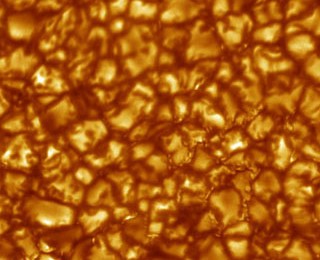
One prediction of General Relativity is that because of the way that gravity affects time, the frequency of electromagnetic radiation (light) emitted at the solar surface should decrease as it escapes the Sun’s gravitational potential well, i.e., the solar spectrum should appear gravitationally redshifted. Surprisingly, according to this recent paper by Takeda and Ueno, that prediction had yet to be definitively verified…until now.
